Sunday, September 12, 2021

About the "army of dwarves"

  Dwarves (on rams)

The minions of thorin oakenshield arrival to the battle of the five armies.

An spanish blogger, Francis, wrote an entire about the very sad recent death of the great Steven Weinberg. In that entire he used an expression that I had never heard, but that I find very accurate. He opposed the figure of a giant like Weinberg to the nowadays status in physics that he referred like "an army of dwarves" .

Francis doesn't talk too much about the meaning of that expression, but it is self evident: one of the giants of the past (remember the Newton expression "in shoulders of giants") wrote a key paper and some significant part of physics changed forever. And some of the greatest of the pasto could write a few bunch of those papers. Now, on the contrary, most papers are coauthored by many people. They write ten or more papers, similar to others of other groups of peoples working on the very narrow area of physic and the field barely changes, if at any.

How have we arrived at this point? 

First I would say some things about Steven Weinberg. He was the most prominent figure, together with Gerard t'hoofs, of the generation that created the standard model. That generation culminated the work of all the twenty century physics in a beautiful model and they can claim that they have been the last generation of theoretical physicists that have achieved a verified success. The next generation bring first supersymmetry and later string theory, that were well motivated theories, but they can't claim the same level of success. Subsequents generations working on that topics have desvirtuarted the field to the point that I would call it hypothetical physics instead of theoretical. Since a time I am beginning to say as a joke? that I am in the field of death sciences, in the same sense that latin and old greek are  death languages.

 One more thing about Steven Weinberg. Despite it's big influence he couldn't convince the USA government to build the SLC (superlunar colder) which took his county out of the leadership of particle physics, in favor of Europe and it's CERN colliders. Possibly, but it is imposible to know, it has slowed down the progress of particle physics for decades because, maybe, it could have found new physics that can't hardly be found in hadronic, circular, colliders. That moment is also related to the time the USA changed it's economical structure into a country that has, since them, become less and less attractive for people with an interest in pure science, but the details of that are another story.

Going back to the dwarves I'll introduce another term "academically correct" that refers to articles that are analogies of the more pejorative aspect of "politically correct", that is, articles that are formally correct, but low risk. that lack any aspiration of any major originality, because, you know, if you deviate from the stablemen you "don't appear in the photo". That is, your article is not cited, and probably even readed, and that means that your have no points in your CV to for the 50+ applies for a new two years scolarship you could get, if you are very lucky, in whoever knows which lost place of the world.

 Even if your are world famous physics it's easy that none reads you if you are too original. That has happened to Gerard t'hoof, with it's search of a relationship between fluid dynamics and quantum mechanic, to Penrose in may of this works, but also to, for example, Nima Arkani-Hamed. I was two year ago to a congress in Madrid about the topic of the swampland, where assisted Vaffa (he has published an important article in the subject by that time), and two major experts in superstring phenomenology in Europe, Luis Ibañez, and Dieter Last, among many others.  The last day arrived Nima, to give two speaks. He talked, among other things, about his work in the amplithuedron, and, despite it's prestige, and that everybody knew the existence of that line of work, and that they had the general idea that it should probably interesting, I got the impression that none on the audience had actually read in deep anything about that line of investigation.

Why is people going into that behaviour. That is a controversial question. Maybe, if you are a neoliberal, you could consider that it's because of lack of competence. But that doesn't fit to really, because, as stated, people in academy already are under extreme pressure to get even the worst, bad payed scholarships in remote places, even if you have been the best of your generation at your university and have, since them, made some hard work in some important universities on your field (I know some cases that fit that profile). Also you can say that is because there is too much "leftism", with a loose of meritocracy because of a desire of inclusion. And that, depending of your area of investigation (that applies outside of physic mainly) there are tabu topics, and probably that is true. I would say that now the academic world is a place that has to face the worst part of the neoliberal polictics (that fit very bad the requirements of research in pure science) and of leftists politics. The result is that the academic world is loosing importance.

That leads to "scientific work" outside academy. That is an oxymoron of course. There is not such a thing as scientific work outside academy. It is technological work (ok, in some very excepcional case it can be applied science, but never pure research). 


Nowadays mathematics, and variants, such as "mathematical engineers", statics and alike are very demanded for certain kind of works in enterprises, in areas such as "financial economy" (another oxymoron), assurance companies and "big data" and "machine/deep learning". Well, that people are actual mathematics of the same type that Nicola Tesla was a physicist, i.e. they are not at all.

The point is that in a globalized world, where neoliberals govern economy, everything is modeled in enterprises, and more people on enterprises have no idea about how science works, They have no idea on the difference between pure science, applied science and technology. It doesn't mean that they are stupid or bad people (many of them are for sure, but also for sure there are very competent, smart and good people). But the thing is that most people in the world neither have a glance of the details of science, including the people that surround that dirigentes, and because they are rich, sucesfull people, they think that, enforcing academy to work like their enterprises they will get better science, or, worst still, that the right place of a scientific is working on an enterprise, when the fact is that purse science simply doesn't exist in the enterprise, and that, if pure science freezes applied science comes a few years later, and, at the final point technology also freezes, and possibly we have already arrived there.

Friday, February 08, 2019

Fluctuating physic as a new type physics for LHC and successors

  I have been absent from this blog for a long time, basically since the LHC bumb went away, but not from physics. In the last days Sabinne Hossenfelder has been again doing posts against the idea of making new coliders as, for example Why a larger particle collider is not currently a good investment. I had already written a post, years ago, saying that it is necessary to make new coliders, and hope that  Europeans and Chinese make one.

  The topic of this entry is somewhat related to the LHC bumb. Let's remember the affair, an statistical in the LHC as around 3.5 $$ \sigma $$ was found and a lot of  paper trying to find an explanation for it were published. A few mounts later the LHC published new data and the fluctuation had gone away.  The usual interpretation was that the fluctuations were of pure statistical nature, which, of  course, is the most rational interpretation, but here I wonder if beyond the standard model at least part of the new physic is a new kind of physic and that signal,, pointed that new kind of physic.

   Before that fluctuations some others had been found, but with minor statistical significance, to later vanish.. Also, since them another ones had been found, and some have gone away also while a few others are waiting for new data to determine their fate.

Well, clearly statistical fluctuations are something that are very common, and it is not at all surprising to find them. In fact that is the reason of the $$ 5 \sigma$$ criteria to claim a discovery, and even this very high statistical significance could become not enough with the very large amount of data that the LHC is getting, according to some claims in Tomasso Dorigo's blog.

To understand why I use the expression "new kind of physic" we must wonder what we understand as a particle. In particle physics we have quantum fields, and they create particles. That particles created by the field have a definite mass, charge (under whatever gague group it is charged) and cross section of production but, could it be otherwise?

Well, if I wrote this entry is because I am considering that possibility. In that case maybe we have "erractic" particles that are defined by the possibility that their properties (mass, charge and coupling constants to standard model particles) can vary in time and/or space.

The idea of varying coupling constants is not new and goes back to Dirac, but usually it was considered that the considered coupling constants were the standard model ones, specially, the $$ \alpha$$ electromagnetic constant. My idea is that, someway, the standard model could be stable, but the should be new (low energy, in the sense of well bellow the planck energy, but still high energy for the earth colliders) physics could be unstable, with fluctuating characteristics. In his recent papers about the issue of whether string theory allows or not the existence of a deSitter vacua he mentions the possibility that the coupling constants of physic beyond the standard model  could variate, but has not gone too far on it. .Lubos also has said in some posts that that variations should be related to moduli and they would have inconvenient statistical properties in cosmological data. That means that I am aware that there could be difficulties with the proposal, but still I think it is interesting to say a few things more about it.

To understand how this could happen we must go to string theory, but, in order to get it somewhat easier, we coould begin by the kaluza-klein scenario. As is well known there there we have a single extra dimension compactified in a circle. There a scalar field fit the relation

$$  p_\mu p^\mu - \frac{n^2}{R^2}=0 $$

 That implies

$$ m_n=\frac{\mid n\mid }{R} $$

If the scalar field is a self interecting one, thorough a $$ \lambda\pi^4$$ (or maybe another power, it is not  really relevant) the 4d coupling constant is related to the 5d one by

$$ \lambda_4=\frac{1}{R} \lambda_5 $$

Where V is the "volume" of the extra dimension, in this case $$ V= 2 \phi R $$

Well, now it comes the key ingredient, the way that we assign a value to R. It is a well known problem that was resolved assigning an scalar field to the geometrical moduli of the compactified space (in this simple case the radius of the cylinder) and a potential to the moduli so that the actual radius corresponds to the minimum of the potential of the moduli field. Still moduli stabilisation is a difficult issue. Usually the potential is generated by fluxes associated to the antisymmetric fields arising in string theory and sourced in branes. Still to get an stabilisation of all moduli is something that one put's by hand to avoid runaways, and to get defined values of the quantities but the question is that maybe we are prejudicing and that, in general, not all of them the  are stabilised and that the physics beyond the standard model is not constant.

 In a simple K-K scenario a variation of the radio doesn't give a grate variation of the masses and constants.  If we change $$  R \mapsto R + \Delta R $$ the the mass changes as

$$ \Delta m_n= \frac{\mid n \mid }{R + \Delta R}=\mid  n \mid \left (  - \frac{1}{R^2} \Delta R  + o \left (  \Delta R^2 \right ) \right ) $$

In more general settings that Kaluza Klein the details are different in heterotic, F-theory, "plain braneworld" type II A, etc, but the dependence of the coupling constants on the inverse of the volume of the extra space  remains true. In fact the mere KK mechanism is not too much the key ingredient determining the new physics and everything is more involved. One must first get a compactification that makes that the remaining supersymmetry is N=1  and later to chose some symmetry breaking mechanism, usually through a superpotential, and part of the characteristics of the low energy physics is fixed by that superpotential (others depend on the topology of the compatification space, and even in the metric, which  is generally unknown, even in the simplests cases)  The superpotential usually has perturbative and not perturbative contributions (instantons) but still depends in the geometry of the compactificated space.

 I tried to do all the details  in a generic scenario, the one described in a Dust and all paper from 2008  The LHC String Hunter's Companion but at last I considered that not being a payed investigator it didn't worth the effort.

But, in fact, the new physic searched by the LHC were not only superpartners or particles associated to new gague groups, usually some new U(1). Some star predictions for the LHC were micro black holes and Kaluza-Klein tower of the graviton in the Lisa Randall braneworlds scenario, and also that phsyic depends on the size of an extra dimension, which was assumed to have a fixed value. Still more interesting, in that scenarios the extra dimension was expected to have a size a lot bigger than the usual compactification scale. Previous to the braneworld there was the ADD scenarios, that is mathematically simplest.

 In ADD the cross section to form a black hole in a collision of energy E is:

$$ \sigma (E) \sim \frac{1}{V_n M_*^{n+2} }\left ( \frac{E}{\sqrt{V_n M_*^{n+2} } }    \right )  ^\alpha  $$

 Here $$ M_* $$ is true the (4+n) dimensional Planck scale (the 4d one would Mpl) The relation between them is different in ADD and in RS. In RS the relation  is:

 $$ M^2_{pl}= \frac{V_n}{M_*^{n+2}} $$

In ADD is:

$$ M^2_{pl} = \frac{M_*^3}{k}(1-e^{-2\pi k R} ) $$

The key ingredient is again present, the cross section depends on the size of the extra dimension. If this extra dimension size varies with time, the cross section of production of black holes is not constant. Even if it varies in space and not in time we have that as the earth moves in space it will move to zones with different value of the size, and them of the cross section.

 I haven't searched in deep for the formula giving the dependence of the kaluza klein tower of the graviton but I am sure that it also depends on that size.


As I said at some point I am aware that maybe there are possible issues with the "erratic particles" scenario, and may be it is impossible in string theory anyway. For sure there are people that know string theory far better than me that could explain the issues in the improbable case that they consider that my proposal deserves their attention.  And even if the scenario could be viable I have not made any estimation of what the variations of the sizes could be expected to be, nor the exact influence in a concrete realistic model of the variations of the measurable masses and coupling constants or whatever associated to the size variations.

One possible way to get that estimation could relay in cosmological considerations, but my knowledge of string cosmology is too bad to even try to purchase that objective. The only thing that I could conjecture is that maybe some properties of dark matter are fluctuating, and, perhaps, that could explain the very controversial claim of DAMA/LIBRA observation of an annual modulation of dark matter detection.

 But, going very weird, we could think that physics beyond the standard model is not described by string theory but that, still, the properties of that new physic are not constant.

In any case the only really important thing is the LHC is searching for new physic in the conventional way, expecting that the characteristic of the new physic is as stable as the characteristics of the standard model physics, but may be that is a wrong starting point. Maybe there is something special in the standard model that makes it robust against fluctuations, but the same thing doesn't apply to the extra physics.

 If true the people doing search for new physics should design a way to distinguish between statistical fluctuations of the type they are actually considering and another ones that are generated because the actual new physic is fluctuating. My knowledge of such issues is so null that I can even give a gimp of how they would do it.

And, to end my return to bloging, and the main reason for it: please, ignore Sabine campaign and build the FCC or whatever new collider you can!


P.S. I haven't mentioned it in the post, but there is a very important aspect in this scenario. The fluctuations in the new physic would not be random but there would be important correlations. One toy model is one in which there could be to possible particles A and Be to be produced in a collision. A would have certain value Qa of a certain charge (that would not be fluctuating) and a mass that maybe fluctuates among a central value $$ Ma= MCa \pm  \Delta Ma$$ and the same for the particle B. The cross section of production would depend in many factors, but, mainly, in some coupling constant that would fluctuate. The key point would be that according to the coupling variations one would have periods where the production of A would be much more favourable, and another where the production of B would be the preferred one, and periods in between, giving some characteristic pattern. If there are more particles and coupling constants involved the pattern would be more complicated, but still there would be one, and maybe that kind of patterns would make the search simpler that if the fluctuations would be pure random.

P.S. 2 In the type of scenario I describe (see Mitchel comment for the suggestion of an slighthly different one) I think that string theory would gain because if correlated fluctuations are detected some aspects of the goemetry of the compatification could be inferred form low energy physics, something not quite possible in the standard wisdom.

Thursday, December 10, 2015

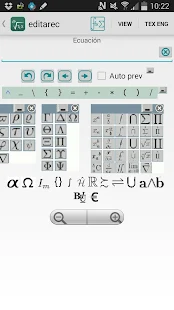
Android aplication to edit mathematical equations in latex

I have been looking for a long time for a good android app that would allow me to edit equations, and get the latex code of it, but I haven´t found nothing really good, untill now ;-)

 The first big step was my script smart note.  It makes a great work in recognizing a handwriteen equation, and allos to export the latex code to a tex file.

 But, in order to use it to write equations for a blog (or paper) I rather need to get the latex code writen to the wallpaper. For that purpose I begun writing an small app myself that imported the equations of that program. Althought my script makes a great work it doesn't allways recognizes things as you wan, so I decided to make a full equation's editor that can modify the imported equations, and ,of course, make an equation from zero. I have added symbols for most usual latex symbols, and also for the unsual. As far as I know the app is the most complete latex editor on the google play. It has a lot of symbols, and you have lot of flexibility to rearrange them to meet your preferences.

 But I didn't stop there. In a typical use one needs to write some equations once and again, or variants of them, and it is pretty stupid to write them from scratch every time. To ride with that the app allows to save the latex code of the equations, together with additional information that allows to search them, in a database so one can construct it´s own equation's agend.

Once you have an equation you have buttons that copy the equation to the clipboard so you only need to paste them into the destination. It even wraps them with the tags corresponding to blogspot (if you use matjax), wordpress, or forums that are latex enabled (there is a button for every purpose).

If you have a note device (phablet, or even better, tablet) you can use the multiwindow features and use my app side by side with a document reader from wich you are actually copiying the equations, or a web navigator, or the blogspot/wordpress apps, or whatever you need, so you are far more productive.

I have made two versions of the app. The basic one, that is free (and withouth google adds by now) contains all the mentioned functionality. It is available at Google Play since now here

The free version is very complete, and powerfull, but there is a full version that has best quality graphs, and aditional features (export of registers, to share among devices, or other people, import the equations from a latex file in your device, etc) that will be available pretty soon ;-).

 Beeing a blogger I have made it to make easy the most usual tasks of a scientific (mainly a physic) blogger, but It also makes a great work to write equations for a paper. As far as I know I honestly think that it is by far the best, and most complete equation editor in the android market, and, althought I don't know all the equations editors available, I think that even in windows there is nothing as complete and easy to use. But, of course, it may be because I have made it and I know how to use it, maybe others don't agree. In any case I hope you kike it, and find it usefull :).

Tuesday, July 28, 2015

Stringy summer cinema

This summer, as usual, there has been two major string conferences. One of them is the strings 2015, celebrated in India, and has been announced on the Lubos and Woit blog. The most relevant page of the conference contains the talks and includes links to the slides and videos to most of the conferences. I have seen some of them and my idea is to see all of the most relevant ones. Until now the one I have liked the more are the Maldacena one "Quantum mechanics and the geometry of spacetime" where he talks about the basics of black holes quantum aspects and from there he goes to his conjecture, to the correspondence ER=EPR, to the fluid-gravity duality and to some still to develop "Entanglements is the fluid mechanics of gravity" or something like that, that sounds really intriguing. Another very interesting one was the one by Ashoke Sen "Surviving in a metastable de Sitter space-time" It studies how the actual mass of the Higgs, on the metastability zone, represents a treat for the survival of the universe because there could be a transition to a most stable one in a given point and that region would grow to the speed of light. That is well known, but the new thing is that an small cosmological constant makes our universe more safe against that problem, and also discusses how having redundant information in sufficiently separated points you can be well assured against that danger. Ok, the stirngs 2015 has been announced in the blogs (although not as much as it usually was some years ago). But the thing is that recently in Madrid there was another very important string meeting String Phenomenology 2015. As with the strings 2015 there are links to the slides of the talks, and to the videos. The only difference is that instead of youtube the videos are located in another server and I am not sure for how long they will be available. The talks covers topics in string cosmology (mainly inflation). some of results and expectatives from the LHC lot of F-theory phenomenology and a few other mixed topics. Untill now I have just begun to watch the video of Eva Silverstein, that I find somewhat confuse so I can't say too much, but you can read more (in spanish) form the Francis blog El estado actual de las predicciones en teoría de cuerdas Wll, it has been really a large time that I had not written here. I hope next entry would not take that long ;-)

Saturday, October 04, 2014

Why it is a good idea to build a new supercollider

Sabine Hossenfelder has posted an entry in it's blog claiming that maybe it is not a good idea to build a new supercollider: Is the next supercollider a good investment?. I have nothing aagins Sabine, but I disagree with his arguments, and I have ansered her in her facebook. Because my answer has been long enought I have decided to copy it here in the form of a brief blog entry. I seriously disagree with your viewpoint about this. Perhaps the most important reason is that you are neglecting the dark side (matter and energy). We have overhelming evidence that the standard model is not the whole history. In fact we know that it is only an small part of the mass and energy of the universe. The fact of not knowing from direct evidence nothing about the major cinstituent of the universe means that we have very few predictive power about it. Of course we ca learn from the dark side by other type of experiments, but at the end of the day if we need detailled knowledge we need to product it in a collider (if we can). On the practical size, well, untill know the most of aplications from the standard model (the specific part that only theorethical physics study of it) come from neutrinos. That is because they can go througnt matter quite easily. Well, dark matter also can do that, but at slow speeds. If at some time we know how to product it and how to detect it in a reasonable way we could learn a lot abut solid objects, as for example, the earth, that are not available by other means. And you have also the possibility that dark matter is not simple -a single particle- and maybe you could do it for build something. Another point is the Higgs. We know that it existes, and it's mass. But we also know that itself alone is somewhat exoteric, I mean, the problem of it's raunaway mass and the naturallnes question. We had expected that something very special should existe at near the higgs mass, and we have barely beguined to explore that energies. Maybe we could say that naturalness was not a good idea, but note before studiying that range of energies in deep. And that drives me to another point. We even have not run the LHC at full energy. Maybe we could find a lot of things when it does. Even the mini black holes (and the associated braneworld scenaries)are not fully discarded at present for the next energies as far as I know. And that ,for sure, would be a great, great discover. I am almost sure that if there are mesoscopic extra dimensions and we can build miniblack holes there will be a lot of new aplied physics that will be build upon it. And about SUSY. well, it is a pain in the ass, I agree. But the fact is that it's non existance would be somewhat tantalizing. My main point about it is that local supersymmetry brings a theory of gravity, and I would find a bizarre coincidence that we have a theory of gravity and a well motivated theory of particle physics that gives gravity, and that both are unrelated. I am sure that I could elaborate a lot more on many of the subjects but I guess that anyone interested could do it by himself.

Sunday, June 29, 2014

Strings 2014

Long time since my last post. There is no particular reason, just a mix of circunstances. I write now to advise, if someone is still not aware, about the annual convention about string theory. The slides, and vídeos, are available online at talks online Based on previous experience with similar cases I warm potential watchers about the fact that the videos usually are available online for a limited amount of timpe, typically one or two weeks, so harry up!

Tuesday, December 31, 2013

A prety good year ending in Arxiv

After a somewhat disappointing year in theorethical physics where the greater topic seems to have been the black holes firewall discussion (seemingly settled in a long - around 90 pages- paper) the end year in a promising way. One one hand we have the second paper of the famous Amplituhedron construction (I told about it in my spanish blog when it appeared) that was announced by Nima Arkani-Hamed, but of which we only had seen a somewhat introductory paper. This is the second one: Into the Amplituhedron. I have not read it, neither I did it with the first. I still am reading, from time to time, a previous long paper about grassmanians and all that. I hope I'll give a reading to the first, and to the one of today, soon, but I guess that Lubos will write a fair better post about it that anything that I could do. I must acknowledge to Lubos the pointing to another paper. Gravitation from Entanglement in Holographic CFTs. I had not paid attention to it because almost like a question of principles I don't pay attention to papers with the fancy names "holographic" or "entanglement" in the topic. But this time it looks pretty important because it looks like is they have made a great advance in a constructive derivation of general relativity from some thermodynamics consideration, improving the previous work by Ted Jacobson. But better read the entry in Lubos Blog Einstein's equations from first law of thermodynamics in AdS. A very different type of article is Stars in M theory (made up of intersecting branes). The title is surprising and the subject certifies that we are in front of a very exotic paper. We study stars in M theory. First, we obtain the analog of Oppenheimer -- Volkoff equations in a suitably general set up. We obtain analytically the asymptotic solutions to these equations when the equations of state are linear. We study perturbations around such solutions in several examples and, following a standard method, use their behaviour to determine whether an instability is present or not. In this way, we obtain a generalisation of the corresponding results of Chavanis. We also find that stars in M theory have instabilities. Therefore, if sufficiently massive, such stars will collapse. We discuss the significance of these (in)stabilities within the context of Mathur's fuzz ball proposal. The last paper I consider is this: Inflationary paradigm after Planck 2013. The first author is the very creator of the idea of Inflation, Alan guth, and at first sight it would seem a review of resoluts. In fact is somewhat of a reply to another paper, but still it is a good way to get an idea of how the Planck results have affected our view on Inflation. One last words for my previous entry. After a discussion of it in an spanish forum I was pointed to an old paper by Tholman - http://authors.library.caltech.edu/2596/1/TOLpr30d.pdf- and, seemengly, it could be considered in the kind of ideas discussed there. My example could be translated to emission of photons between bodies orbitating a central one. The gravitational blue/red shift would play the role of the expanding/contracting universe red/blue shift and that would accommodate into a stationary situation. If the difference of blue/red shift energy is greater than the temperature difference (boltzman factors mediated) then an inverse Clausius behaviour is possible. The key point is that the Clausius Law is not equivalent to the formulation of increase of entropy in a general relativistic setup and this last kind of law still holds, at least in static (probably stationary) gravitational fields, but I am not sure about how the same would still hold in a general spacetime.

Thursday, October 24, 2013

Spacetime kills the second law of thermodynamics, real or paradox?

  This summer, among many other things, have read the famous book of Susskind and Lindesay about black hole information paradox. Casually just after finishing ir's reading I have to teach in private tuition (hope I am saying it right ) statistical mechanics (a conventional introduction with the main average topics). In doing that I have revised the foundations of it from the viewpoint of what I had read in the Susskind, and also some other aspects that one must face when triying to apply  statistical mechanic reasoning to non physical problems (for example ecology (I collaborated with a guy working in mathematical ecology for a while).

  There are a few things that I am thinking about, but for the present entry I will concentrate in an easy mental experiment that, at least apparently, violates the second law of thermodynamics. The key of the violation is the lack of a proper definition of energy in general relativity, but for the present case I don't even need to go into mathematical details about it. My idea was clear, take a situation where that problem in the energy definition rises a paradox that violates the second law. I tried a few strategies that possible also work, but in the end I found a really easy one that I think is simple and representative.

 I have found that the easier way of attack is to use the Clausius enunciate: No physical process can transfer heat from a cold body to a warm one. The way to circunvate the law is as follows: Take two  "black bodies", for example the canonical ones consisting of a cavity with photons in equilibrium with the walls that are at different temperatures. Now in the warmer one open the also canonical small hole that allow a photon, or a few ones, to scape. This is made in an expanding universe, the photons that have exit form the body travel in that space time loosing energy. Them they arrive at the coldest body. The photons of the warmer body initially had more energy that the ones in the coldest body, but now, after travelling in the expanding space time, arrive to the second with less energy that the photons in the cold body. That means that the cold body becomes coldest after it gets in equilibrium with that photons. Now we make the reverse procedure, we send some photons from the cold (now coldest) body to the warmest one. But, as this is an imaginary experiment, choose to do so when the universe is contracting (for example we make the experiment in the edge of the time when a FRW goes for the expanding to the contracting phase). In the travel on this contracting universe the photons gain energy and when they arrive to the warmest body they can be, if we wait enough, be more energetic than the ones in equilibrium with the warm body and so they actually  drive it hotter. As far as we can make the experiment as far as we want from anything else we are in a closed system and in that closed system we have effectively transferred heat from a cold body to a hot one, breaking the second law.

 Of course we have not counted the entropy of spacetime, but how could we do so? In the Hawking laws of black holes we learned that classical gravity worked as entropy, the area of a black hole playing the role of entropy. And  it is well known how the Hawking radiation, a semiclassical effect (so taking quantum mechanics into play) gave a further argument. String theory (and ulterior works using  only geometry and CFT, the kerr/CFT correspondence) gave microscopic support to that correspondence among gravity and thermodinamics. And also are were known the, probably wrong, ideas about gravity as entropy, that have gained a rebirth with the paper of Verlinde about "gravity as en entropic force". But in this mind experiment I don't use nothing special in GR, something like an horizon, or quantum effects. Neither is any claim about saying that gravity is entropy. The whole point is that, if there is no mistake, if you don't know how to count the entropy of the spacetime, in this nonstationary case, you can violate the second law of thermodynamics, and that looks very unfunny, isn't it? ;)

 The most similar situation that I know is the famous case of Hawkings telling once (and later felling shame about the idea) that in a contracting universe entropy would go in the opposite direction, and the worries of Sean Carrol and others about the thermodynamic arrow. But as far as I know none made such an explicit case as the one I am presenting here.

 Just to avoid some trivial criticisms I clarify that in GR the energy of a body (or a system of bodies) is the time component of a cuadrivector, so it is not an invariant. As E=Q-W (first law) and \[ \Delta S= \Delta Q /T \] entropy also should be some time component of some cuadrivector and that makes it's precise definition somewhat tricky, but as far as I see this experiment could be suited in a single reference system so we don't need to care about that things.

 Well, this is the idea, and probably I am making some very trivial mistake, or this simply has already been considered and discarded, but as I don't know for sure than that is the case I present the idea here so anyone can blame me if necessary ;).

Friday, September 27, 2013

Conference about the inmeditate future of particle physics afther the Higgs discovering

As you can have read in the Peter Woit blog this week there was a meeting in Madrid, in the institute of theorethical physics, auspiced by the CSIC (consejo superior de investigaciones científicas, close to the UAM , autonomous university of Madrid) with the title " Why mH= 126 GeV? .

 The conferences have been recorded in video and are available online (including the slides). This morning is having place the last set of talks. IT begins at 10 00 so if you live somewhere in the UE maybe you still can get a plane and arrive to the dinner after the last talk, or, if you live in Madrid you can get the next train or bus to Cantoblanco and probably you could arrive to most of the talks.

 I find the topics pretty interesting from a phenomenology viewpoint because some clues on where to be reasonable to watch for new physics. I'll try to post some review of the most interesting ideas exposed if I find time for it.

Monday, May 06, 2013

Proposal for an Ig Milner prize (or trantor prize)

 Ok. Now that we have the Milner  prize I think that it is time to go a little bit further. The nobel prize has it's counterpart, the Ig nobel, so it would be fun to have an  Ig Milner. or Trantor prize`. remember Trantor is the planet that is the centre of the galactic empire in the Asivmovs book's about the foundation.  In that literary universe physics has discovered almost everything and the physicists mainly get prestige by doing formal or ideological revisions of the already established physics which have not consequence in making new discoverings (they even don't care about it).

 Well, the idea would be to give a symbolic prize to works that are superficially correct but are totally useless, or even make no sense at all when one looks at it's closely. I think that they would also be works which are specially ambitious and prepotent. To avoid injuring people who is beginning and could get too injured in their professional life by the bad press I guess that it would be better that the candidates to the prize would be people with a well established position.

 Also it could be given a prize -maybe in an slightly separate category- to papers that are correct but specially fun, or exotic.

 For the first edition I would make a few suggestions.

 One candidate would be the AMPS paper about firewalls. Better than trying to explain the details myself  I suggest reading some posts of Lubos on the subject, this being the last one at the date of writing this:

An apologia for firewalls


 An even better candidate, in my humble opinion, would be Lee Smollin for his last book. I would link the Lubos review but I think that would be to unfair because it is well known that "crackpot" is the more polite word that could characterise Lubo's opinion about Smollin.   That's why I give a link to Sabines blog, who also have a closer knowledge of Lee because she was a former collaborative of him: Book review: “Time Reborn” by Lee Smolin.

 Well, my last candidate would be for the exotic side. It is an article where the author - Benjamin K. Tippett - designs a metric that could fit a literary writing by Francis Wayland Thurston. The whole felling of the paper is something like a scientific description of the worlds of chuthlhu. I give here the link and the abstract:


Possible Bubbles of Spacetime Curvature in the South Pacific


In 1928, the late Francis Wayland Thurston published a scandalous manuscript in purport of warning the world of a global conspiracy of occultists. Among the documents he gathered to support his thesis was the personal account of a sailor by the name of Gustaf Johansen, describing an encounter with an extraordinary island. Johansen`s descriptions of his adventures upon the island are fantastic, and are often considered the most enigmatic (and therefore the highlight) of Thurston`s collection of documents. 
We contend that all of the credible phenomena which Johansen described may be explained as being the observable consequences of a localized bubble of spacetime curvature. Many of his most incomprehensible statements (involving the geometry of the architecture, and variability of the location of the horizon) can therefore be said to have a unified underlying cause. 
We propose a simplified example of such a geometry, and show using numerical computation that Johansen`s descriptions were, for the most part, not simply the ravings of a lunatic. Rather, they are the nontechnical observations of an intelligent man who did not understand how to describe what he was seeing. Conversely, it seems to us improbable that Johansen should have unwittingly given such a precise description of the consequences of spacetime curvature, if the details of this story were merely the dregs of some half remembered fever dream. 
We calculate the type of matter which would be required to generate such exotic spacetime curvature. Unfortunately, we determine that the required matter is quite unphysical, and possess a nature which is entirely alien to all of the experiences of human science. Indeed, any civilization with mastery over such matter would be able to construct warp drives, cloaking devices, and other exotic geometries required to conveniently travel through the cosmos.

 Of course everyone is free to make his own suggestions, and, if they don't like the idea, to explain their reasons.

Thursday, March 21, 2013

And the third milnor prizes goes to Polyakov (maybe)

I didn't write a single line about the second milner prize so I'll write a brief post about the third.

 As can be read in "not even wrong" and in the blog of matt strassler it seems (but is not confirmed at the time of writing this entry) that the winner of the this third prize is Alexander Polyakov.

 Everybody who has ever read a book on string theory know the name because of the Polyakov's action and the Polyakov path integral that are the very basics of the worldsheet aspect of string theory. Besides string theory Polyakov has made very valuable contributions to QFT such as instantons and magnetics mopopoles.

 All in one it is clear that the prize is absolutely well deserved. In fact my only concern is why he hasn't also a nobel prize. It is absolutely clear that there are people awarded with a nobel who have by far less merits than Polyakov for the prize. Well, at this point I think that among theorists the milner prize should be more valued than the nobel not only for the money but for the prestige of the previous winners.

 By the way, if someone wonders why I write so few posts in the last times there is an easy answer: The LHC is doing a hard work to hide any possible evidence of physics beyond the standard model. The Higgs is of the most boring type possible and no SUSY, no extra dimensions no nothing. Well, this is not the end of the world for theorethical physcis and it is sure that some surprises could be around the corner (but maybe not where people usually expects them xD) but it would have been fun to have some BTSM physics in colliders at this point.

Friday, November 23, 2012

Mathjax, note 10.1 and more


I have become really tired of the problems to have a proper way to display math in blogspot. I had previously used a latex renderer but I have had problems with it. On one hand the server has changed in a few occasions, and in another the blogspot people have deleted the modifications of the template that allows the to be used.

 Because of that I had become somewhat frustrated. After all some entries with maths in this blog doesn't work any more and I don't like the idea of change the template every time that the server of latex changes in the future.  I have been observing that from a months to now the Lubos blog uses mathajax and it looks like it is an stable solution so I have decided to give it a chance.

 This a text equation using the mathajax plugin:

 $$  ds ^2=H^{-2} dt^2 + H^2 dx^2 $$

Ok, to have an easy way to display formulas is fun, but it is only part of the game. You need to write them. That seams a trivial task, write the latex code. Yeah, it is truth, I know the latex code for math and I know how to write a full Latex document also, of course. But, you know, that is "last year technology. I mean, this year has arrived the note 10.1, the tablet version of the note family of tablets. It was presented in February  at the MWC in Barcelona (Spain) and it arrived the stores (and my home the very first day it was on sell) this September. Among the many goodies of that tablet is the math handwriting recognition that you can see working in this video:


That feature works really ok. it recoginzed well ther formula  (the plain text handwriting recognition works also fine, of course) and send the equation to wolphram alpha (if you want so) but it has an annoying aspect, it doesn't allows you to get the latex code that correspond to the formula. This feature has also been added to the phablets and I have used it in the note 5.3 (the original) form around march, long before getting the note 10.1. That means that writing an equation using latex has become a "too primitive" way to do things.

 Well, I have been learning to do android programs. But as far as I have had a bad experience in the recent past with writing for the symbian platform (I ended an app, send it to the nokia store, passed the quality standards, but never seen it published in the store so I have not made any money of the app) I have been somewhat reluctant to get too involved in that business. Still I have learned enough to know the theory of how to do a virtual keyboard that could allow write latex in a really easy way. I mean, for writing an alpha letter you need to type \alpha, and similar for other greek letters. It would be easiest to have an \[ \alpha \] symbol in the keyboard and that when you type it it would appear in the suggestion bar (candidate view) the option to write the latex code (that would be the default one), the mathajax code or the actual character. And similarly for many other math symbols. Maybe in the future I could make this keyboard, but if somewhat reading this blog entry decides to do it before I wouldn't ask him any money for the idea ;).

 Well, a latex keyboard would be fun. But it would be better still that the math recognition of the note would allow the option to show the latex code. I know that there is a SDK for the S-pen of the note, but I don't know if it allows access to the code of the math recognition program (I seriously doubt it, but I still have not watched too much the SDK). If so it would be fine that somewhat would try to write a variant of the S-note program that would include that latex presentation option. Of course if someone of Samsung reads this entry they are invited to include that functionality in an update. I really like the note tablet and I absolutly think that is the best tablet of the moment, specially for people who need to use equations often. If that LaTeX extra functionality is added it would convert a wonderful product into an even better one :)-
 

Sunday, August 12, 2012

The arrival of the Milner prices of fundamental physic

This month came by surprise a new international prize for physicists. It is oriented for works of relevance in theoretic development, even if the theories worked hasn't be tested and they can't probably be for a large amount of time. It is created by a Russian physic doctorate Yuri Milner and it is named Fundamental Physics Prize.
It has been widespread announced in the English blogosphere. I also wrote a brief note about it in my Spanish blog and made publicity of it in some Spanish blogs about science. Since them I have not seen too many news about it. I neither have seen any signal of it in the TVs or newspapers of my country. That is too bad for a prize that in it's monetary recompense gives 3 million € to any winner and it has awarded, for it's first edition to NINE people,. That is, it has given a total amount of 27 million € to the physicist community. I think that only because of it it deserves a lot more of attention ;). Another point about the prize is the relevance of the winners. In the most theoretical size we have to Ed Witten, Juan Maldacena, Nima Arkani-Hamed, Nathan Seiberg and Asoke Sen. All of them are big names of string theory related research. Of course the most famous of them is Ed Witten who already had got in the ninties the field medal (the most famous and prestigious award in mathematics) for it's work in topological field theories. Probably next to him in fame is Maldacena and its broadly known correspondence. Nima is more on the phenomenological size with its work in possibly mesoscopic extra dimensions that have generated a lot of work for a few years (including the variant of them by Lissa Randal) and also had raised the possibility of creation of black holes in the LHC. Now this possibilities have something been gone with the null results of all the experimental searches but still there is a minor possibility of discovery when the LHC gets a bump in energy (or maybe when more data is available). In the last times Nima has been working in twistor techniques for amplitudes in certain kinds of maximal supersymmetric theories that, probably, can in the future be extended to more phenomenologically viable theories. Nathan Seiberg is well known by his works together wit Ed Witten. In particular he is well known for its cohomoloy. A teacher of a seminar in algebraic geometry told us that when his theory was announced during a course all the assistants started to use the new calculational tool to reobtian in a easiest and fastest way the cohomological groups of very well known spaces. Asoke Sen, on the other side, has made work in many areasm, but it is best known by it's work in tachyon condensation. I will not say any more and pont the interested reader to a post on it's work by Lubos motl: Asoke sen and tachyon condensation Well, there are winners in other subjects. For example in cosmology we have two very well known people, Andre Linde and Alan Guth. Guth is the father of inflationary theory and Linde the cofather who got the original idea and mutated it into the "eternal inflation" paradigm. Undoubtedly (at least for me) their work is the main contribution to the field of cosmology in the last decades and only the lack of a firm experimental verification of the idea has prevented them fro winning a nobel. There are also two other winner who works in quantum computing -Alexei Kitaev. and in mathematics (related to physic) Maxim Kontsevich whose work inspired Ashoke sen. I don't know about them so I will not say anything else. Overall the prize and the winners (at least the ones I know) are all really top people. Still the prize didn't get as mediatic as it should and I wonder why. Well, for sure there was a way in which the prize could have deserved a lot more attention from the mass media: awarding to Stephen Hawking who is probably the most famous physic alive. So the question is should Hawking have deserved the prize? Well, in my opinion he would. In fact I think that he was the ideal candidate to win it. It's work in emission of radiation for black holes has inspired lot, lot of work (the last line of research the "firewall" that according to some people is in the inner of old black holes). In fact it's work is considered the most firm candidate as the first quantum effect related to gravity. It the radiation would have been detected in an actual black hole (and not only in condensed matter analogues) hawking would have wined for sure the nobel prize. Hawking now is old (and as everybody knows, it¡s health is weak, because of it's illness), and it is probable that he would die without seeing it's idea tested experimentally. Sooo...YES! he would have wined the Milner prize as a recognition to it's work. Ok, there will be more editions of the prize, but unfortunately (let's hope not) the next year could be too late. Definitively not awarding Hawking looks to me both not of justice and a lost opportunity to make the prized best known. Well, even without Hawking the prize is great, and the awarded people are famous and important so let´s hope it will get the deserved media attention. Ok, I have talk about the winners of this year, who will win the next edition?. The decision is among the winners of this year (that is the dynamic of the prize). Maybe in the next 12 months it is made some really bright works that totally rocks, but among the already well known people, who should be potential winners? I see two major candidates (who, of course, could have already have win this year, but ok, it was necessary to choose someone and not everybody could win). I am talking of Cumrum Vafa and Joseph Polchinsky. I invite the readers to propose some more names. After all this kind of games are a part of the way to make a prize famous. Ok, it is too early, but still it could be interesting, when the date of the next edition arrives it could be made another round to see how the candidatures have evolved ;).

Wednesday, July 25, 2012

Strings 2012

The LHC rules the physics blogosphere, specially since it's recent announcement about the Higgs. None doubt of the importance of the discovery and, in general, the labour of the LHC. But that doesn't meant that nothing else is going on on physics. On the experimental side we have new experimental results on dark matter detection: on the negative by xenon amd on the possitive (but in a very non fable way because of the early state of the experiment) by COUPP-4 On the theoretical side also there are some news. For example those last days we have assisted to a "black hole firewall" revolution of which I'll make a separate entry soon. But, in the theoretical side, I think that it is quite important to notice that this weak have begun the annual congress in string theory, that is, strings 2012. The place where it is celebrated is the Ludwig-Maximilians-Universität (in collaboration with the Max Planck institute). This is the web page Strings 2012
Some slides are available (and I guess that the links with an x that actually don't really have a pdf although they point to one in the future will have it). Some videos are also available. I'll try to see some of the important conferences and to read the slides. For now my next post is planned on the "firewall revolution" but maybe I'll post also another entries about this conference. Update: You can read a brief analisys of some of the conferences in Lubo's blog Strings 2012, a few words

Sunday, March 04, 2012

The LHC blues

Ok, I am being deliberately a little bit negative in the title. But the sad truth is that the runs of the LHC at the 7 TeV centre of mass energy have been somewhat bit disappointing in the respect of bringing us confirmed new physic. It has been a long time since my last post in this blog (I have keep posting in my Spanish blog) and in the while there were some interesting claims, extensively reported in the blogosphera such as the famous OPERA maybe super-luminous neturinos and the corresponding maybe rectifications. Also there were some claims about anomalies in LHC b related to CP symmetry violation, recently confirmed by the CDF analysis. A pity that this can be own to bad calculations in QCD and not to new physic. This negative results have also meant that most of phenomenological models for new physics have been driven into a very bad position. The only real almost discovering has been a Higgs at 125 TeV. Now we are near to a restart of the LHC activity to a somewhat increased energy, 8 TeV. And it is expected a lot more luminosity (around 19 fb^-1). So, maybe some new physics could appear, or maybe not. In the purely theoretical side I have not seen any revolutionary paper, and not even a simple "good although not amazing" one. At most some curious ideas that are beautiful but not particularly useful. Ok, again maybe I have been too negative again, but if you compare the amount of exciting new results in physic with the ones in fields such as consume technology (with a mobile/tablet revolution going on) and the revision that society and economy are undergoing right now high energy physics is going very slow. Anyway, I have keep reading most blogs, some of the new papers and rereading with care some not so new ones so I will come to blog again with some more regularity. Of course if the LHC is merciful enough to give as some new physic to deal with I will be happier with the task ;).

Monday, August 29, 2011

Geometric Models of Matter

The last Friday there was a very interesting paper in arxiv. I am really busy those days (and it will be so until around the 15 of September)so I couldn't still read ot completely. Still I think that I must leave notice of it here.

The paper in question is title like the post entry, Geometric Models of Matter. It has three authors: Michael Atiyah, Nicholas S. Manton, Bernd J. Schroers. Among them the best known one is, of course, sir Michaell Atiyhay, a very well known field medallist in mathemathics.

The abstract of the paper reads:

Inspired by soliton models, we propose a description of static particles in terms of Riemannian 4-manifolds with self-dual Weyl tensor. For electrically charged particles, the 4-manifolds are non-compact and asymptotically fibred by circles over physical 3-space. This is akin to the Kaluza-Klein description of electromagnetism, except that we exchange the roles of magnetic and electric fields, and only assume the bundle structure asymptotically, away from the core of the particle in question. We identify the Chern class of the circle bundle at infinity with minus the electric charge and the signature of the 4-manifold with the baryon number. Electrically neutral particles are described by compact 4-manifolds. We illustrate our approach by studying the Taub-NUT manifold as a model for the electron, the Atiyah-Hitchin manifold as a model for the proton, CP^2 with the Fubini-Study metric as a model for the neutron, and S^4 with its standard metric as a model for the neutrino.

Ok, as I said I still didn't read the full article so I can't say many detaills. But the idea seems simple. They are inspired in the Skyrme modell. There there is a group-valued field from :$$mathbb{R}^3$$

$$U:mathbb{R}^3 \rightarrow G$$.

where the lie group is usually SU(2). In that construction specific characteristics of the proton and neutron (baryon number and so on)are associated to topological constructions, that aare, automatically, conserved quantities.

In the paper they generalize the idea in order to construct another particles, for example the electron. They must choose different kinds of manifolds, and maps. Also they use different topological invariants and so on.

But the idea is that they try to describe matter, and it's associated charges, in basic to purely geometric/topologyc constructions. Of course we are talking about different constructions that the one's involved in gauge theories. The proposal of Atiyah and all somewhat replace the need of an ordinary QFT to begin with. IF I have understood right they only have by now an static construction, that is, they don't have a way to give a dynamics to their theory. That means that it remains a lot of work to be done before they get something remotely similar to the actual world.

But, still, it is a beautiful (at least mathematically) idea. For sure Einstein would have loved it. Let's remember that in GR the space-time has a geometric nature while matter has a non-geometric one. In that sense it is an inelegant theory. If this construction works we would have a fully geometric description of the universe. If that works the immediate answer would be: the resulting theory would be equivalent to ordinary QFT in curved (well, maybe we would first ask for flat space-time9 space time for usual situations? would it give some advantage, other than aesthetic? could it be promoted to a quantum gravity?

Whatever the answer to these questions could be I think that it looks like a theory that deserves some further development. Even if it fails like a viable physical theory it could be a source of new ideas for existing ones.

Monday, May 30, 2011

Great day in arxiv

Today there are in arxiv two articles that look really great.

The firs (in the order that arxiv gives to them) is from Samir D. Mathur: Effective information loss outside the horizon.

It argues that there is no loss of information inside a black hole because he information simply doesn't go inside the black hole. The abstract explains it more carefully:

If a system falls through a black hole horizon, then its information is lost to an observer at infinity. But we argue that the {\it accessible} information is lost {\it before} the horizon is crossed. The temperature of the hole limits information carrying signals from a system that has fallen too close to the horizon. Extremal holes have T=0, but there is a minimum energy required to emit a quantum in the short proper time left before the horizon is crossed. If we attempt to bring the system back to infinity for observation, then acceleration radiation destroys the information. All three considerations give a critical distance from the horizon $d\sim \sqrt{r_H\over \Delta E}$, where $r_H$ is the horizon radius and $\Delta E$ is the energy scale characterizing the system. For systems in string theory where we pack information as densely as possible, this acceleration constraint is found to have a geometric interpretation. These estimates suggest that in theories of gravity we should measure information not as a quantity contained inside a given system, but in terms of how much of that information can be reliably accessed by another observer.

The other article is written by Maldacena: Einstein Gravity from Conformal Gravity.

The abstract is:

We show that that four dimensional conformal gravity plus a simple Neumann boundary condition can be used to get the semiclassical (or tree level) wavefunction of the universe of four dimensional asymptotically de-Sitter or Euclidean anti-de Sitter spacetimes. This simple Neumann boundary condition selects the Einstein solution out of the more numerous solutions of conformal gravity. It thus removes the ghosts of conformal gravity from this computation. In the case of a five dimensional pure gravity theory with a positive cosmological constant we show that the late time superhorizon tree level probability measure, $|\Psi [ g ]|^2$, for its four dimensional spatial slices is given by the action of Euclidean four dimensional conformal gravity.">We show that that four dimensional conformal gravity plus a simple Neumann boundary condition can be used to get the semiclassical (or tree level) wavefunction of the universe of four dimensional asymptotically de-Sitter or Euclidean anti-de Sitter spacetimes. This simple Neumann boundary condition selects the Einstein solution out of the more numerous solutions of conformal gravity. It thus removes the ghosts of conformal gravity from this computation.
In the case of a five dimensional pure gravity theory with a positive cosmological constant we show that the late time superhorizon tree level probability measure, $|\Psi [ g ]|^2$, for its four dimensional spatial slices is given by the action of Euclidean four dimensional conformal gravity.


Unfortunately until the next Friday I am going to be very busy and I badly will have time to read them carefully those days so I can't say too much more about them. I suppose that (at least) Lubos will talk about them so I will read its report before I can read them myself. I write this entry partially to recommend the articles to however could be interested and also to keep a link to them so I could later have a quick access to them from wherever I want.

Update: Well, at last I had no patient and read the first article (after all is a brief one, only 7 pages). I have a mixed filling about it. The author computes a few things related to the fall of a body towards an event horizon. Firstly he does for an Schwarschild one.

There he considers two cases. The first in the free fall. In that case the last light (containing the info about the object) is emitted, because of the red-shift at a frequency bellow the Hawking temperature and so it can't be differentiated from this and he concludes that we actually don't have the information about that object.

The second case is when an observer at infinity holds the infalling object until the last time. In that case it is the unrhu radiation associated to the acceleration of an object at rest respect to a gravitational field which is responsible for a dissipation of the information of the object when it finally is released and cross the horizont.

Later he calculates similar things for a Reissner-Nordstöm like black hole and he finds that somewhat different mechanism operate in order to get similar qualitative and quantitative results.

In the last part he does calculations using string theory and the fuzzball paradigm for black holes (where the notion of event horizon is replaced by an stringy construction). Still he finds equivalent results.

Certainly the fact that many different calculations lead to a similar result is appealing. But still I don't see clear the whole subject. I think that at best he would be saying that the lost of information happens before the horizon (or its fuzzball "equivalent") so the problem of lost of unitarity remains (and even we could say that is getting worst because it happens in a region causally connected with the outsider observer). But the whole thing is that one could think that a priory we could think that if the outside of the black hole is clean of other infalling matter (other that the actual object under study) we could argue that if we know the state of the object at infinity we can apply the laws of quantum mechanics to know t's state when it is falling (eve it we can't actually do a measure to be sure that nothing has perturbed our object). That contrast the case of the object that falls behind the horizon when we have no idea of which it's final state would be because we don't know the laws of quantum gravity near the singularity. Well, I am ware that this last objection is somewhat wrong because the key point of the lost of information is the horizon and not the singularity but I have no more time just now to see what point I am missing. I'll realize it for sure later, but I don't promise to write it here soon. But keep calm, for sure Lubos will write about it sooner or later and will clarify the relevant points ;).

Tuesday, April 19, 2011

Can we see inside black holes?

The last week there was an article that was commented in the arxiv blog: Planets Could Orbit Singularities Inside Black Holes.

The blog entry discuses this article: Is there life inside black holes?.

The article is a pure classical relativity article. It study the possibility of stable orbits for planets inside a black hole, in particular in a Kerr-Newman black hole, that is, a rotting charged black hole. The classical geometry of a Kerr-Newman black hole is described by it's Penrose diagram:


The essential aspect of the K-N black holes for the work of that people is the presence of the inner horizon (a Cauchy horizon). In a non rotating black hole, described by the Schwarschild metric, once he cross the event horizon the radial coordinate changes it sign acquiring a time sign. That means that one must go in the direction of decreasing radius until one finds the central point-like singularity. A common interpretation of that geometry is to say that inside the black hole the space itself is falling toward the centre at the speed of light and it drags averything with it.

In the K-N case things are somewhat richer. In addition to the outer event horizon there is an inner cauchy horizon. When the black holes spins faster and faster (or when the charge of the black hole increases) both horizons get nearest and nearest until, ultimately, they would converge and it would become an extreme black hole.Beyond that one would have a naked singularity but it is thought that such a possibility should be ruled out.

well, as a I said te key point was the cuchy horizon. AS you can read in the linked wikipedia article a Cauchy Horizon is a boundary for the validity of a well posed Cauchy problem in partial differential equations. It can be shown that light (or whatever wave) crossing the horizon gets an infinite blue-shift. That means that it's energy-momentum tensor diverges. The implication of it would be that the back-reaction would destroy the Cauchy horizon once a particle cross it. Still one could get an stable Cauchy horizon if one throws in it exotic matter violating the AWEC (average weak energy condition) well known for people working in wormholes.

The reason why the cauchy horizon is important is because once it is crossed the radial coordinate becomes once again space like. That opens the possibility of the existence of stable orbits inside the black hole. In previous articles, cited by the author, it was shown the existence of that orbits for Reisner-Nordstöm (charged) and Kerr (rotating) black holes. The present article generalizes the results to the general case. In the article considerations are hold about the tidal forces, sizes, radiation rates and they conclude that in a galaxy centre sized black hole a planet could do an stable orbit around the singularity and hold life.

Well, this is the content of the article. As I have explained it is worked in the ansatz of the validity of classical relativity inside a black hole. Also it depends strongly in the stability of the cauchy horizon that can't be got without exotic matter. Note: the author doesn't mention that point about exotic matter although he is aware of the fact that cauchy horizons are not stable. Without exotic matter the whole paper is of a purely academic interest even if one accepts that classical general relativity is accurate to describe black holes inners.

Of course there are a lot of people who don't like classical GR for doing so. In string theory there are many alternative descriptions. On one side one has the correspondence principle of black holes (due to t' hooft and Suskind) that says that an observer falling into a black hole will not be able to notice when he has crossed the even horizon. That means that the physic he sees is must be equal that the physics seen by an outside observer. The reason of the introduction of that principle is the intent of saving unitarity in the presence of Hawking radiation. The actual reasoning is made not classically but for the Hilbert space of a quantum theory as seen but inner and outer observers.

Another string theory inspired viewpoint is described in a classical article by Maldacena: D-brane Approach to Black Hole Quantum Mechanics . In the last part of that article, after calculating the Beckenstein-Hawking entropy, Maldacena Suggest a view where black holes inners and Hawking radiation is described in terms of D-branes. I am not aware if that suggestion has been further developed. I have made a partial search for "hawking radiation in string theory" but I haven't found too much. In fact, beyond that Maldacena article, I found only an approach written some years before using a very aproximative description.

Another paradigm for black hole inners in the string literature would be the fuzzball approach of Mahupart (or maybe Mithur I am not sure at this point and have not time to do a search just now).

Well, that variety of viewpoints, not very compatible among them, for the black hole inner is disappointing. Even in the simpler case of the general relativity viewpoint is disappointing the possibility of the existence of stable structures (maybe planets of an advanced alien civilization, maybe a much more prosaic rings of dust) existing inside the black hole hidden for us from the event horizon.

But, wait! The title of the post wonders about the possibility of seeing inside the black hole. Of course classically it is impossible because of the very meaning of "event horizon". But when quantum mechanics enter the game thing could change. Of course the key would be Hawking radiation. The semiclassical theory says that the radiation must be purely thermodynamic so we can't get any info from it. But if unitarity is conserved the Hawking radiation can't be purely thermodynamic and it must have some structure that stores all the structure of the matter that formed the black hole and that has fallen inside it after it's formation. Possibly it will also have some information about the inner structure of the black hole. Obviously to get that info is very difficult in practice. The usual analogy is to say that one could reconstruct, in principle, the form of a living object from the ashes that are produced when it is burn.

But if we are a little least ambitious maybe we could actually get some partial information. Maybe we could design some easy mental experiment in which throwing into the black hole some specific kind of matter in some specific way we could analyse the Hawking radiation related to it to get some information of the inside of the horizon. That would actually be very cool because it would give an experimental way to distinguish the competing descriptions of the black hole inner.

Of course I actually don't know the details of how this could be done (only a very vague ideas that probably will not work). But maybe something on this purpose is already made and a kind reader would give me the references ;).

Thursday, February 17, 2011

String theory in exotic R^4

Today in arxiv there is a very curious article:Quantum D-branes and exotic smooth R^4 written by Torsten Asselmeyer-Maluga, Jerzy Krol.

The article is actually the second part of a previous one: Exotic smooth R^4 and certain configurations of NS and D branes in string theory.

The abstract of the first (in date order) article reads:

In this paper we show that in some important cases 4-dimensional data can be extracted from superstring theory such that a) the data are 4 Euclidean geometries embedded in standard $\mathbb{R}^{4}$, b) these data depend on NS and D brane charges of some string backgrounds, c) it is of potential relevance to 4-dimensional physics, d) the compactification and stabilization techniques are not in use, but rather are replaced. We analyze certain configurations of NS and D-branes in the context of $SU(2)$ WZW model and find the correlations with different exotic smoothings of $\mathbb{R}^{4}$. First, the dynamics of D-branes in $SU(2)$ WZW model at finite $k$, i.e. the charges of the branes, refers to the exoticness of ambient $\mathbb{R}^{4}$. Next, the correspondence between exotic smoothness on 4-space, transversal to the world volume of NS5 branes in IIA type, and the number of these NS5 branes follows. Finally, the translation of 10 dimensional string backgrounds to 4 Euclidean spaces embedded as open subsets in the standard $\mathbb{R}^{4}$ is achieved.

I still haven't had time to read the full article, but it looks quite interesting, and beautifully, specially from the perspective of someone whose favourite area of maths is topology. The idea is to see if someone can make string theory in a background of R^4 with a different differential structure than the usual one. One of the most amazing discoveries of differential topology was that there were different differential structures for R^4 than the usual one. That means that although like a topological manifold R^4 is unique there are different differentiable manifolds that are compatible with it's topological structure. An explicit characterization of that exotic structures in terms of coordinate is difficult and their existence is proved by means of topological techniques. In the paper it is made use of h-cobordism.

Later he begins the string theoretical construction, using SU(2) WZW (wess-zumino-witten= CFT's, NS 5 branes, D branes, etc. AS I still haven't read the article carefully, nor the continuation of it (the today's arxiv article ) wouldn't give more details. Only to say that it looks like a very intriguing area of research.

Also today in arxiv there is a very interesting, but much more conventional article of Miche Dine: Supersymmetry from the Top Down whose abstract is:

If supersymmetry turns out to be a symmetry of nature at low energies, the first order of business to measure the soft breaking parameters. But one will also want to understand the symmetry, and its breaking, more microscopically. Two aspects of this problem constitute the focus of these lectures. First, what sorts of dynamics might account for supersymmetry breaking, and its manifestation at low energies. Second, how might these features fit into string theory (or whatever might be the underlying theory in the ultraviolet). The last few years have seen a much improved understanding of the first set of questions, and at least a possible pathway to address the second.">If supersymmetry turns out to be a symmetry of nature at low energies, the first order of business to measure the soft breaking parameters. But one will also want to understand the symmetry, and its breaking, more microscopically. Two aspects of this problem constitute the focus of these lectures. First, what sorts of dynamics might account for supersymmetry breaking, and its manifestation at low energies. Second, how might these features fit into string theory (or whatever might be the underlying theory in the ultraviolet). The last few years have seen a much improved understanding of the first set of questions, and at least a possible pathway to address the second.

The article is quite pedagogical, and even begins with an ultra fast introduction to supersymmetry. Certainly recommendable.

On the subject of supersymmetry in the LHC era I thing that everybody would must read the last entry of Jester's blog: What LHC tells about SUSY that discussed the paper of the ATLAS collaboration: Search for supersymmetry using final states with one lepton, jets, and missing transverse momentum with the ATLAS detector in sqrt{s} = 7 TeV pp.

Well, certainly the expectations of Lubos of an early discovery of SUSY in the LHC are gone, but still there are good reasons to be patient, as explained by Lubos himself or by the Dine's paper.

By the way, while writing this entry I have seen that Lubos himself has written an entry about the Dines paper, you can read it here. At the moment of writing my entry he hasn't given many details about the article, but possibly he will edit his post and discuss the paper in more detail.

Update: Lubos has read this entry and has written a very intersting essay about the general relevance (or irrelevance) of the pathological mathematical structures in physics .

About the actual series of papers in exotic R^4 he doesn't say too much because he claims that he doesn't understand the paper. I have been studying the subject, including some references, and I am still going on. Much of the mathematics (differential topology: h-cobordism, topological surgery, tubular neighbourhoods) are familiar to me, but some more recent concepts are new to me. Still I think that I can follow the general argumentative line of the mat part. I get somewhat more loose in other points of the WZW model in an SU(2) background, but still I think that I get the general argumentation. As soon as I end reading a few more references I'll try to expose the key ideas.

Anyway, there is a difference here with the case commented but Lubos. R^4 is the only R^n that admits different smooth structures for the same topological structure. In that aspect it is not a case of searching for a pathology but a case where the pathology appears by itself. In fact most people who have heard about that particularity of R^4 have always though that maybe that could be the ultimate reason that we live in a four dimensional manifold. Of course what they lacked is a way to relate that peculiarity of R^4 to any actual physic. This people seem to have advanced somewhat in that direction, but as far as I understood they are far of the objective (if that is their objective, that probably it is not the case).

Friday, February 11, 2011

String theory and nanotechnology meet today in arxiv

String theory deal mainly with physic at the planck scale, although it's goal is to connect to with the electroweak scale.

On the other hand, nonotehcnology, deals with physics at sizes similar to the Bohr radius. There are, consequently, many orders of magnitude of difference among that two branches of physics.

Because of that it is absolutely amazing to see in the title of the paper a reference to a relation among them. But today in arxiv we have such a paper: Fermionic condensate and Casimir densities in the presence of compact dimensions with applications to nanotubes.

The abstract reads like this:

We investigate the fermionic condensate and the vacuum expectation value of the energy-momentum tensor for a massive fermionic field in the geometry of two parallel plate on the background of Minkowski spacetime with an arbitrary number of toroidally compactified spatial dimensions, in the presence of a constant gauge field. Bag boundary conditions are imposed on the plates and periodicity conditions with arbitrary phases are considered along the compact dimensions. The boundary induced parts in the fermionic condensate and the vacuum energy density are negative, with independence of the phases in the periodicity conditions and of the value of the gauge potential. Interaction forces between the plates are thus always attractive. However, in physical situations where the quantum field is confined to the region between the plates, the pure topological part contributes as well, and then the resulting force can be either attractive or repulsive, depending on the specific phases encoded in the periodicity conditions along the compact dimensions, and on the gauge potential, too. Applications of the general formulas to cylindrical carbon nanotubes are considered, within the framework of a Dirac-like theory for the electronic states in graphene. In the absence of a magnetic flux, the energy density for semiconducting nanotubes is always negative. For metallic nanotubes the energy density is positive for long tubes and negative for short ones. The resulting Casimir forces acting on the edges of the nanotube are attractive for short tubes with independence of the tube chirality. The sign of the force for long nanotubes can be controlled by tuning the magnetic flux. This opens the way to the design of efficient actuators driven by the Casimir force at the nanoscale.

I haven't read in deep the paper, but in a superficial reading I have got a confirmation that they are actually claiming that actual aspects of the compactified extra dimensions of string theory could, through the Casimir effect observable consequences in the characteristics of nanotechnologic materials, in particular nanotubes. My guess is that there must be some error, or some trick, somewhere. If not this paper would be driving string theory from the realms of cute edge speculative high energy physics to actual applications in one of the most economicaly profitable industries. Too good to be truth probably, but, who knows? Well, I'll read the article carefully sooner and I'll comment more details. But I doubt that I would be the only one to say something about it ;)-

Update: Ok, the article actually doesn't relate string theory extra dimensions and carbone nanotubes. IT only applies the formalism of compactificactions to nanotubes, based on the premise that a nanotube is a cylinder, i.e. a compactified plane. The introductions, and many other parts of the article are somewhat misleading and seem to suggest what I had explained. Also it is misleading the fact that it appears inhep-th. The reason for that possibly is that they make some development of the formalism of compactifications in a general, multidimensional, framework. Possibly that general development could be usefull for people working in string theory, that possibly justifies the inclussion of the paper in hep-th although the primal subjecto of the paper is condensed matter physic.