Friday, April 30, 2010

Sparticles


Supersymmetry is easy, isn't it?. I have posted (in spanish) a brief introduction to the subject. And I'll make more posts abut it. I am almost sure that everyone who has passed a course in QFT can understand the basics of supersymmetry.

After all, you have a superpartner for every particle, that has opposite statistic. You have funny names for the superpartnerts. The partner of the electron is the slectron, the quark has the squark, etc. And for bosonoics fields the thing is easy also. To the photon corresponds the photino, to the gluons the gluino, to the higgs the higssino, etc.

Well, them if you remember that for every broken global symmetry there is an associated particle, the goldstone boson them you know what a goldstino is. Isn't it?

Well, if you read the book that gives title to the entry(the full title is theory and phenomenology of sparticles) you will realize that maybe the goldstino could not be exactly what you think.

And, of course, you will learn a lot more about phenomenology of N=1 supersymmetry in 4 dimensiones. That includes the MSSM, cosmology of supersymmetry models, etc, etc. The books is from 2004 (reprinted in 2007) so it is, I guess, terribly outdated. I find it a lot better option that the,somewhat similar in it's purpose, book of Michel Dine (supersymmetry and superstrings). Ok, this book doesn't cover superstring, and it has many more pages. But with the actual trend of growing interest in phenomenology, motivated by the dark matter experiments, and the beginning of operation of the LHC it looks as a good reference book to get good info about the characteristics of neutralino, methods of supersymmetry breaking or whatever.

P.S. I'll try o update the previous posts, as promised, as soon as possible.

Wednesday, April 28, 2010

Enrique Álvarez on vacuum energy decay

When I studied theoretical physics in the UAM the everybody (well, at least everybody studying he specialty of theoretical physics) favorite teacher was Enrique Álvarez. Possibly, I don't know because I never coincided with him, today Ibañez could discuss the crown, but in that times Ibañez was in CERN and didn't teach.

Particularly great was his course in an asignature devoted to classical mechanics where he explained constrained lagrangian system, and the Dirac way to deal with them. That supposed that I had not any problem in the future understanding quantization of gauge theories, string theories, BRST operators and all that which is a great advantage. Also his course in general relativity was great.

Well, I am happy to see today in arxiv an article of him totally worth to post about: http://arxiv.org/abs/1004.4867

The article makes comments, and insights, on a previous work of Polchinsky the one of the Polchinsky action)in 2007: http://arxiv.org/abs/0709.2899 (I think he talked about that topic in the strings 2008 conferences celebrated in CERN)

The idea is that in de Sitter space the vacuum is not stable in the presence of interactions among particles. I am still reading both articles so I will not comment on them now, but I will edit this post (yes, I promise xD) as soon as I read them and explain what's going on.


But I am sure that some readers of this blog, who also had Álvarez as a teacher, will not wait me and read the article themselves. After all the requisites for reading are mainly some familiarity with basic QFT and quantization on curved spaces. In fact one of the points of this post is to advise them of the existence of the article and so avoid the possibility that they would miss it.

Friday, April 09, 2010

Á guide for anonymous LHC backholics

A few days ago it was published on arxiv the following paper: Black hole/string ball production, possibly at LHC

I am busy reading any, many things nowadays and I couldn't read it immediately - despite of it's few number of pages - but today, at last, I read it.

The main interest of the papers is that it makes a quick review of the ideas that lead to the proposal of black hole creation on the LHC and to it's characteristics. Most interestingly still, it gives references to the relevant literature.

One of the focus +of the paper is the way on which the Hawking radiation is expected to behave. It is said that the first expectation was that most of the radiation would be send t Kaluza-Klein models of the gaviton that scape to the bulk. In particular a paper stating that was: A Model for High Energy Scattering in Quantum Gravity (note that the article treats other aspects as well).

Later it was argued that instead there would be a lot of hawking emission into brane particles: Black Holes Radiate Mainly on the Brane . In this paper, like in the others, the treatment is semiclassical. No construction of black out of D-branes is used. Neither Hawking radiation is described by string theory objects. Such descriptions exist, to a certain extent, but are not developed enough to use them in this contexts. In fat an analytic description of a black hole in braneworlds is inexistent even in classical gravity and some reasonable approximations have to be made. This approximations are valid for small black holes whose size is much smaller than the length of the extra dimension.

The amount of radiation send to the bulk or to the brane is important. If all the radiation is send to the brane no Hawking radiation would be observed in the LHC.

Well. I think that this article is citing mainly orthodox string theory friendly papers. Be aware that other people argue that a microcanonical statistical ensemble would be necessary. In that assumptions the lifetime of the back holes could be large enough to leave the detectors (but still there woulld, of course, no danger of earth swallowing black holes).

The theme of black hole emission has behind it a lot of publications and many, many, possibilities have been conjectured. One of that is the possibility of formation of a "cromosphere" or an "electrosphere". By that it is understood that the hawking radiation reorganizes into a permanent orbiting matter that obstruct the rest of the outgoing radiation to some extent. A recent paper in arxiv (sorry, I have no time to search the reference now) argues against it.

Also there have been more exotic ideas. For example Louis Crane abrogate for the possibility of creating black holes by collapsing large clouds of dust, of a few tons, by means of implosions. He argues that the resulting black hole would emit in supersymmetric modes and that the radiation could be modulated to use the black hole as a device to impulsate spaceships able to go into other solar systems. I have discussed this, and the one of microcanonical ensembles, possibility in my other blog. You can search there for them (if you speak Spanish).

As the readers could guess some of the suggestions in the literature have more wide acceptation, possible with very good reasons, that others. And, except for the Louis Crane idea, all depends on braneworld sceneries. Recently there was an article in arxiv that gives a wide sight into realizations of that models into full string theory. When I would have read it I'll try to summarize some of the proposals here.

UPDATE: Today Lubos has commented about an article treating black holes: Kerr black hole: the CFT entropy works for all M,J. Of course it is worth reading.

Tuesday, March 30, 2010

LHC live webcast

Today at 8 30 it was expected that the LHC would make the first collisions at 7 TeV. There has been some problem and one of the beans has been lost. It is expected that around 11 a second try would be made.

You can follow the events in real time in the live webcast

Thursday, March 18, 2010

Strings 2010

I have been reading in the internet about the strings 2010, which this year has place in Texas, for a while. But I had not paid too much attention because I thought that, as usually, the event would be in summer.

Today I have been shocked when I saw a quick note in U duality blog saying that the conferences have been going this week.

This wee I was not particularly busy and if I just would have read carefully the dates I could have seen the livecast (available here).

Well, I still can see the slides of the talks of the past three days and the remaining ones (if the livecast works properly).

Well, at least I can see that still are very important people pending so it still there is some fun.

The most amazing of this is the total absence of mentions to the conferences in the everybody's favorite string theory superhero. Seemingly some global warming supervillian has taken him out from his usual missions ;).

Other than this in the meantime from the last post there has been an announcement about possible dark matter detection (you can read it in resonances, shores of the Dirac sea and , the older entry, in Lubos blog. I am planing to write my own entry, in Spanish, in my other blog).

Also Smoot et all published their second paper applying, as announced, their idea of an entropic force due to CEH(cosmic event horizons)to inflation. I'll post about it sometime in the near future. In particular I'll see if I can say something on how that idea could work together with dynamical horizons formalism for black holes and if it could somewhat influence the picture of black hole evaporation.

Of course there have been other interesting papers. For example a few authors took the F-theory GUT's strategy (that is, phenomenology using local models) to construct an MSSM from F-theory. Certainly it doesn't look that great compared with GUT, but if the dark matter detection is true, and the detected particle is something similar to a neutralino that MSSM F-theoretic scenery could be most easily compatible with that discovery than the GUT. As far as I have been able to think about it one possibility- taken account that in a certain sense F-theory GUTS are a universal extra dimension for the gauge bosons, that is, they live in a 7-brane- would be to seek Kaluza-Klein dark matter. The problem is that the involved gauge bosons are the unification ones and not the electroweaks,as it would be required for viable light dark matter. Well, maybe there are workarounds.

Also I wonder how the Smoot proposal, if admitted truth,could relax the conditions of the Vafa GUT (some of them are related to cosmology) to allow a better fit with a possible neutralino. In fact I would like to be able to analyze that kind of questions myself, but I still need to learn more in detail these questions.A good thing is that since I have the tablet PC I am advancing a lot faster. The point is that these, and for sure others, questions are worth of investigation (they are very close to measurable phenomena). As fr as I see they are much more realistic lines of research that the Verlinde proposal, which still has a good echo in arxiv. Possibly the ultimate reason behind it is not the quality and viability of the ideas but simple the difficulty of them. Easier research have more followers, simply because they offer more published papers, and them academic positions.

That is not exclusive of physic. A friend of me told me that the same thing happens in maths. Well, I understand that this thing happen. But maybe it would be good for science if the academy wouldn't be the only way to go. Or at least if it wouldn't be so burocrathic and there would be intermediate ways in which people could do some paid work in high end physics, at least sometimes, proved that the work is reasonably good. Well, I know it is not going to happen so it doesn't worth to loose time with the idea.

P.S. I'll edit the entry to ad the lacking links when I have a while for it.

Wednesday, February 24, 2010

Entropic force goes nobel

Yeahm I know it is a somewhat misleading title ;).What I am meaning is that a nobel laureate -and a very famouse one, the cosmologist Geogre F. Smoot- wrote a paper (in collaboration with other people) in the subject of entropic force.

It is this: Entropic Accelerating Universe

This is the abstract:

To accommodate the observed accelerated expansion of the universe, one popu-
lar idea is to invoke a driving term in the Friedmann-Lema^ tre equation of dark
energy which must then comprise 70% of the present cosmological energy density.
We propose an alternative interpretation which takes into account the temperature
intrinsic to the information holographically stored on the screen which is the surface
of the universe. Dark energy is thereby obviated and the acceleration is due to an
entropic force naturally arising from the information storage on a surface screen.
We consider an additional quantitative approach based upon the entropy and sur-
face terms usually neglected in General Relativity and show that this leads to the
entropic accelerating universe


Certainly the claim is very ambitious. The authors pretend to explain the observed accelerated universe in terms of the entropic force. If truth it could perfectly be a noble prize winning article.

Certainly it is surprising to see such a respected physicist going into the risk of using a so criticized idea (the entropic force -as an origin of gravity- has received a lot of critics in the blogosphere and also some arxiv papers argumenting against it). Even thought reading the aper one sees that there are a few differences between the assumptions of Verlinde and the ones in this paper.

This authors accept the validity of general relativity. They don't say that is is a consequence of an entropic force in a holographic screen. What they do, instead, is to modify slightly the deduction of the Einstein equation from a conventional variational principle. Their only modifications goes into the usually discarded boundary surface term. It is there where they insert an "holographic screen entropic force" (I guess that this is the kind of terminology that a marketing department would suggest for a mass media successful theory).

It is the boundary term which is responsible for the accelerating universe. The content of the holographic entropic term is, according to the prescriptions of Verlinde, proportional to an Unrhu temperature to an horizon. In that point the authors make a discussion of possibilities of choice (the other alternatives being a Hawking or a de Sitter temperature).

The next section uses a purely entropic force argument to calculate the pressure due to the changes of entropy and the result agree with that of the dark energy.

The concluding section stablish definitively that the entropic force fits the data and wonders about further compatibilities, to be analysed in the future, of the idea related to big bang nucleosinthesis, cyclic models and inflation.

Well, certainly this paper relax the assumptions of Verlinde- which totally break with Einstein gravity- and with that relatively weak change they explain one of the mos puzzling issues of the actual cosmology. I think that still the introduction of the unruh temperature in the surface term is somewhat ad hoc (or at least that it would need further clarification). But the payback of it is very impressive.

Anyway, I am almost sure that this paper is going to be heavily discussed by the usual suspects so it is a good idea for the readers of this entry to keep an eye on them.

B.T.W. for today I had the idea to discus a line of papers which discuss how to extend the Higgs mechanism to gravity. he foundational paper of that topic seems to go back to t' Hooft and this month there have been two papers on the subject. Previously to find that recent papers I had wondered myself about that possibility (considering it with a mood of "what if?"), but clearly I arrived too late and another people have worked in that idea already. Still I think is a nice topic to read about and I will tell something about it in the future.

P.S. If I have to make a guess and it is accepted that the main content of this explanation for dark energy would be the anthropic arguments based on the landscape of string theory the idea of the paper discussed here looks better. As a plus, accepting general relativity it is not obvious that it is contrary to string theory. In fact possibly this article would rise a motivation to discuss "microscopic" implementations of the entropic force idea, as presented in this paper. Or I can be totally wrong. Certainly I had not thought too much about this topic before this paper, maybe it is time to consider it serioulsly.

P.S. 2 A second good point that I see is that the cosmological constant (or any variant explanation for dark energy) is a priori as ad hoc as an "entropic force", s introduced by these authors. And certainly it looks a more elegant solution. Sill I am reticent in some aspects,some kind of circularity "de sitter=>horizont=> temperature=>entropic force=>de sitter", but time, and further thinking, will say.

Monday, February 15, 2010

Let the entropy be with you

This new year "sensation" has been a paper by the well known string theorist Erick Verlinde about a possible entropic force like origin of gravity. The actual paper is this.

The article has been extensively discussed in the blogosphere and I will not add too much about it. The main reason of publishing about the topic is that I commented to a friend it's existence and he asked me for the link. A secondary reason is the possibility to paraphrase Obi Wan Kennoby (or possibly it's master, whose role was played by an actor who actually had a degree in Physics, which of course was the reason because he was a much better jedi that Obi one ; ).

About the paper itself all I can say is that the first paper about Physics was one by the two Verinde Brothers in the topic of Planckian scatering. This about entropic force is the first one I readed in the archos tabletPC that I comment in here. T wirte it I am using a B-move trackball remote mouse + keyboard which is wonderful way to get total control of your PC from a comfortable distance.

By the way, anyone with an undergraduate knowledge of physics which includes statistical mechanics and general relativity and who hs read about string theory in divulgaive books such as the elegant universe can read and understand the Verlinde paper by himself and make his own judgement of it's merits so n advise s needed.

Tuesday, January 19, 2010

Physics everywhere

In science fiction novels of not too long ago it was presented the idea of porting a whole library of textbooks in a pocket computer.

Well, that is possible now. One option are the smartphones, specially the incoming new generation with screens of up to 4 inches or even greater. In today phones it is also possible, but possible the screens are too small to do a decent reading and they are useful more like a way to consult a reference in a given moment that to do regular lectures. There are some workarounds that work for plain text, but are not too good for physics/math pdfs. Also you will need to be sure to know what software to get. For example for android operative systems the only decent way seems to be to go to the document to go suit. For windows mobile, Symbian, or even the Ipne OS there are wider variety of options.

But even with the incoming generation of mobiles (which are lovely anyway because of the many, many features they have)it is better to search for more comfortable options.

In this sense there are to main ways, the internet tablets and the tablet PCs. In fact the different among them is not too clear (possible the internet tablets are smaller). This year, possible inspired by the rumour of an "apple tablet" there are many, many new tablet PCs in the way, covering different ranges of prices and features.

I have decided not to wait and I have purchased one of the first available ones, an archos 9


The name makes reference to the 9 inches of the screen size. The OS is windows 7. There in the market products with 7 inches screens, but I think that for a comfortable reading 9 inches is the minimum size. Also influenced me that the archos 7 (or archos 5 for what matters) used android, which is a baby OS.

So now I have in a device of a size and weight of an slim pocket book all the reference material I could wise (in pdf or djvu format), and I even can run mathematica (I prefer it over matlab). And of course I can do all the other things that one can do with a normal computer. Ok, the performance is worst that in a desktop computer) and a touch screen is not as good (for my taste) as a regular mouse and keyboard. But still it is lovely the possibility of doing physics everywhere. And, anyway, it is not a good idea to charge that computers with too many programs if one wants a minimally decent perfomance.

Well, for sure that has been already possible since a few year with regular notebooks and ultra small notebooks/netbooks, but I think that the tablet PCs make an actual difference. It is definitively fine to keep reading the same arxiv pdf you were reading in your home while you are in the bus or the underground (without the need to fill your house with too many printed papers).

By the way, an important tip. Most pdfs have wide margins that make their reading in a not too big screen awkward (the zoom options of the reading programs not always solve that problem in a the satisfactory way one would expect). It is a very good idea to get a program to crop the pdfs such as Nitro pdf or pdffills. Of course these programs have many other possibilities that just cropping pdfs, but possible that will be the one you will use the most (the second one could, maybe, create pdfs scanning your favourite books).

Well, the technology gives us great possibilities. Lets hope this decade would be better for physics that the past one that, I coincide with Jester (resonances), is possibly the worst in hundreds of years.

Thursday, December 31, 2009

F(rench)-theory

Ok, everybody made speculations about the meaning of the F in F-theory. Possibly the most accepted one was that it was due to Cumrumm Va(F)a. But an article appearing now in arxiv has shown it's real origin.

The authors of the article are Adil Belha and Leila Medari. It is titled "Superstrings, Phenomenology and F-theory". the abstract reads:

We give brief ideas on building gauge models in superstring theory, especially the four-dimensional models obtained from the compactification of F-theory. According to Vafa, we discuss the construction of F-theory to approach non-perturbative aspects of type IIB superstring. Then, we present local models of F-theory, which can generate new four-dimensional gauge models with applications to phenomenology.

It is based on invited talks given by A. Belhaj in Oviedo, Rabat, Zaragoza.

Untill here nothing seems to support my claim of the explanation of the origin of the name. But if you go and see the paper, available in: http://arxiv.org/pdf/0912.5295 one finds that it is written in French. That explains all it ;-).

Fortunately I have a relatively good knowledge of French and I could make a quick reading of the article. It is a good introduction to the topic, from the very beguining explaining the basics of string theory, D-branes and all that. Later it explains the basics of F-theory, of local models and of local F-theory GUT models. All of it in a short article of 15 pages.

Despite the name it doesn't dive too much into phenomenology. But still it gives a good introduction to many aspects of the subject for non initiated people. In that sense it is far better than the blog entry of Jackes Distler about the first big paper of Vafa. And, definitively, it looks like a good chance for Spanish people people interested in the subject but not speaking English and maybe speaking French.

By the way, for those that didn't read the Spanish entry about the CDMS announcement just say that F-theory GUTS predicts that the LSP (lightest supersymmetric partner) is the gravitino, which is not a viable candidate for a WIMP. The CDMS two events finding (irrespective of how statistically significant it could be) is kind of a hint that the LSP is a WIMP (maybe a neutralino) so if confirmed the actual Vafa models of F-theory GUT would become invalidated. Possibly the experts on the subject could recook some aspects of the more phenomenological aspects of the theory (mainly the supersymmetry breaking mechanism) to fit the new data. But certainly the best aspect of the whole construction, reproducing the standard model and make concrete predictions, would go away.

But, as Vafa said in the strings 2009 conferences. That's the bad point of making predictions, that they could be invalidated.

If someone is interested in knowing it I must say that since the CDMS announcement I have decided to study in more detail what heterotic phenomenology can offer. It doesn't mean that F-theory is not interesting any more, but irrespectively of the CDMS I needed to pay more attention to heterotic theories. The CDMS is just a good excuse.

Also I am reading (and in some cases rereading) a lot of articles in black holes (stringy and not stringy ones). You can read about it in my other blog (if you speak Spanish). Still I guess that I will also talk about the subject in this blog in a near future, when I have finished reading carefully a few bunch of articles. For example, today there is an article about the subject of B-h creation in particle collisions: http://arxiv.org/abs/0912.5481.

Other interesting articles today in arxiv are: Unification of Residues and Grassmannian Dualities by Nima Arkani-Hamed, Jacob Bourjaily, Freddy Cachazo and Jaroslav Trnka. The article continuate the MHV program to give a twistorial technique to find scattering amplitudes. I must admit that although I recognize it's interest I am not following too much that developments. Still I think some readers can find it more attractive than me.

Also I would note two papers in dark energy:

Inverse problem - reconstruction of dark energy models

Abstract:

We review how we can construct the gravity models which reproduces the arbitrary development of the universe. We consider the reconstruction in the Einstein gravity coupled with generalized perfect fluid, scalar-Einstein gravity, scalar-Einstein-Gauss-Bonnet gravity, Einstein-$F(G)$-gravity, and $F(R)$-gravity. Very explicit formulas are given to reconstruct the models, which could be used when we find the detailed data of the development of the universe by future observations. Especially we find the formulas using e-foldings, which has a direct relation with observed redshift. As long as we observe the time development of the Hubble rate $H$, there exists a variety of models describing the arbitrary development of universe.

The F(R) theories of the subject refers to approaches where one consider gravity theories with terms in the lagrangian that contain higher order terms in the curvature that appear as counterterms in the renormaliztion program of conventinal quantum gravity (the theory actually is not enormalizable because of the need of infinite diferent terms). There was recently a good review article about the subject and if I have time to read it I will post about that kind of theories.

Also about dark energy is a paper by A. M. Polyakov: Decay of Vacuum Energy .

Abstract:

This paper studies interacting massive particles on the de Sitter background. It is found that in some cases (depending on even/odd dimensionality of space, spins, masses and couplings of the involved particles etc) the vacuum acts as an inversely populated medium which is able to generate the stimulated radiation. This "cosmic laser" mechanism depletes the curvature and perhaps may help to solve the cosmological constant problem. The effect is more robust in the odd dimensional space-time, while in the even case additional assumptions are needed.

Polyakov is a very original thinker, and despite that sometimes it's ideas seems a bit non conventional it always worth reading him.

Possibly there are more interesting papers in axiv today, but I'll stop here.

Good new year to all readers.

Friday, December 25, 2009

Relation betwen the Sokolov–Ternov effect and the Unruh effect

I have been disucisong in my other (and in the miguis forum) the proposal of Crane to use a black hole as an starship impulsor, bases on his arxiv article: ARE BLACK HOLE STARSHIPS POSSIBLE?.

You can read (if you understand spanish) the three post about the suject: 1 , 2 and 3.

While discusing that papers I have ben reading in wikipedia about it's litle brother, the Unruh effect.

As explained there in detaill that effect consist of the observance of thermal radiation by an acelerated observed of what is vaccum for an stationary observer. The temperature of the radiation is proportional to the aceleration: $$T=ha/4\pi^2ck $$ (k is the bolstman constant, the other quantities have their obvious meaning).

To my surprise in the entry is mentioned that there is a claim that the radiation has been observed. In particular it has been claimed to be observed in the Sokolov–Ternov effect: the effect of self-polarization of relativistic electrons or positrons moving at high energy in a magnetic field. The self-polarization occurs through the emission of spin-flip synchrotron radiation. and, in particular:

it was shown that if one takes an accelerated observer to be an electron circularly orbiting in a constant external magnetic field, then the experimentally verified Sokolov-Ternov effect coincides with the Unruh effect.

This results date back to 2005, so they are not new at all. And I am almost sure that they are controversial or someone would have a nobel prize for it ;-). The whole thing is that despite I try to be informed, I have no idea about it. Maybe other readers of the blog also were unaware of it and they could be curious to know.

Thursday, December 17, 2009

Dark matter live webcast

Ok, a litle bit late, but still something is going on:


Fermilab webcast in dark matter CDMSresults

Or, if you prefer you can watch the other simultaneous conference:

http://www-group.slac.stanford.edu/kipac/cdms_live.html

As I am posting late just tell that the main announcement has been already made, two events. That means not a definitive discovering, because of statistical considerations, but certainlly something. Now they are preciselly discusing exactly how significant this is.


Update: If you want to see a summary of the results by the CDMS team, get it here (it is a two pages pdf, without formulae, readable for most people).

Quick summary, as said in CF: if these events are interpreted as signal, the lower bound on the WIMP mass for these recoil energies is roughly 0.5 GeV.

I would add, a good guess (it gives the best possible cross-section) is a 70 GeV WIMP. DAMA claims of dark matter discovering, via inelastic dark matter (that is the WIMP has excited energy state) is compatible with CDMS results in a reasonable parameter range.

I invite you to read the entries on the topic in many of the blogs in my link list (and possibly many others). Although not a discovering there will be a lot of discussion about these results in the near future. And new results are announced for the future, when the new superCDMS would be working.

Update: You can see the recorded video of one of the conferences from this website: http://online.kitp.ucsb.edu/online/dmatter_m09/cooley/

The arxiv paper, still not submitted when I am posting this, is availabe here

There are some discussion in the blogs about the actual relevance of the signal. The most accepted one is a 1.5 sigma result. The discrepancies differ in how to actually consider the background. The data of 1.3 goes with the blinded background (optimized background obtained without knowledge of the existence of the signals). If one use other background one could get as much as (almost) 3 sigmas, or as few as 0. By the way, the very use of "sigma" is more appropriate for gaussian distributions, but it is used commonly for non gaussian ones with the appropriated corrections.

For the future I have read that before de superCDMS it is expected to have data from another experiment, the XENON100. They talk about "early in the 2010". It remains to see what "early" exactly means, and -more important- what the results are.

If one wants to read an easy introduction to the detailss of how CDMS works one can read this entry in the old tomasso dorigo blog. Be aware that Dorigo dosn't like too much supersymmetry and it argues that the (previous) CDMS result convince him a little bit more about that. Curiously he hasn't any entry about this new CDMS dataset.

I had not time to answer Matti to a question in the previous post. I leave here a link to his own view of these results as a compensation: http://matpitka.blogspot.com/2009/12/dark-matter-particle-was-not-detected.html#comments

Tuesday, December 08, 2009

Se rumorea que se ha descubierto la materia oscura

Pues si, pues sí. La famosa materia oscura que forma el noventa y tantos por ciento de la masa del universo cuya presencia se infiere por el comportamiento de la materia visible pero de la que no había evidencia directa parece que al final ha sido descubierta en uno de los numerosos experimentos de laboratorio que actualmente se dedican a su búsqueda.

En realidad hay un grupo experimental italiano que responde a las siglas DAMA que llevan un tiempo diciendo haberla encontrado. Pero por una parte su evidencia es un tanto circunstancial, habiendo hallado variaciones estacionales de cierto tipo de eventos posiblemente relacionados con algunos candidatos posibles a materia oscura. Por otro lado experimentos con una sensibilidad igual, o superior, al DAMA no han encontrado nada. E realidad hay diferencias sutiles entre los diversos tipos de detectores y es posible -pero muy improbable- un cierto tipo de materia oscura que sea detectable por DAMA y no el resto de detectores.

Pero no es DAMA lo que esta ahora en candelero ( a raíz de este post en el blog de Jesster, resonances) sino CDMS, siglas de cryogenic dark matter search. Este grupo ha puesto detectores en una mina de sodio enterrada profundamente en algún lugar de Minessota. En 2007 este grupo entrego un informe negativo dónde ponían unos límites experimentales a las características posibles que podía tener la materia oscura tipo WIMP (weakly interacting massive particles). Se esperaba que ya estuviese publicado el artículo con la nueva remesa de datos, más extensa y tomada con instrumentos de mejorada sensibilidad. Pero se han retrasado y han enviado l artículo a nature, y esta revista ha aceptado el artículo, lo que hace pensar que pueda ser importante. Nature es una de las pocas revistas que quedan actualmente que tiene un contrato de confidencialidad (o como quiera traducirse disclosure) y hasta el 18 de este mes no estará disponible el artículo. Posiblemente ese mismo día también haya otro artículo paralelo en arxiv (libre de descarga para todo el mundo por consiguiente).

Realmente esta sería una estupenda noticia para todo el mundo, excepto tal vez el físico de cuerdas Cunrum Vafa y colaboradores, que en los últimos dos años habían desrrollado un excelente y elaborado modelo basado en teoría de cuerdas que reproducía el modelo standard de partículas sin aditamentos exóticos comunes en otros modelos fenomenológicos, y, aparte, hacía algunas predicciones. Entre ellas que la materia oscura esta formada principalmente por el gravitino (compañero supersimétrico del gravitón), que no es una partícula tipo WIMP. Si se confirma el hallazgo habría que ver si pueden reacomodar su modelo para incorporar este hallazgo sin destruir el resto de características buenas de su teoría.

Por lo que yo tengo comprendido de la teoría F la mayoría de restricciones que utiliza para hacer predicciones se basa en su modelo de ruptura de la supersimetria. Allí usan un modelo de mediación gauge (una variante de algo conocido como modelo de guidicce-massiero usado en modelos de mediación gravitatoria), dónde el mensajero es un bosón asociado a una simetría gauge tipo Peccei-Quin,asociada al axión de la QCD. Es un modelo bastante minimalista dónde casi no hay "sector oscuro" supersimétrico y en ese sentido parece muy buena idea. Pero claro, si ahora deben acomodar un WIMP como partícula supersimétrica mas ligera deberían revisar las cosas -si ello es posible- y posiblemente ese mecanismo de ruptura de la supersimetría sea lo que mas se presta a ello. Otra posibilidad, que a mi me parece muy remota, es que ya que tiene un WIMP -el neutralino mas ligero (un neutralino es una combinación del zino, fotino y higgsino) como posible NLSP (aunque la mejor opcion es un stau)- tal vez haya un mecanismo extraño de decay que pueda llevar a que haya WIMPS sueltos por ahí, y que el gravitino siga siendo el LSP (y por tanto el componente mayoritario de la materia oscura). Por las características del CDMS no podría detectar el gravitino. En fin, estas son especulaciones rápidas, y posiblemente con mi aún paupérrimo entendimiento de esas partes de la teoría F quizás sean demasiado arriesgadas. Por si acaso le he preguntado a motl (que también ha posteado la noticia en su blog http://motls.blogspot.com/2009/12/cdms-dark-matter-directly-detected.html), y en su respuesta parece estar de acuerdo con de lo que yo digo.

Como quiera que sea, le pese a quien le pese, si realmente se ha descubierto la materia oscura estamos ante un acontecimiento histórico. Es más, podría tener consecuencias para el experimento del LHC pues posiblemente este debería ser capaz de producir esta partícula recién observada, y así tendríamos una doble confirmación (aparte de una guía muy exacta de como afinar los detectores del LHC, lo cuál hará mas fácil la detección).

Tuesday, November 24, 2009

Introducción a la supersimetría II: El modelo de Wess-Zumino


Había escrito, hace ya tiempo, una entrada sobre supersimetría, esta. Continuo el tema introduciendo una realización de dicha supersimetría en términos de un lagrangiano sencillo, lo que se conoce como el modelo de Wess-Zumino. Quien no tenga muy recientes sus conocimientos de teoría cuántica de campos, y en particular los tipos posibles de spinores, puede leer sobre ello en esta entrada de mi otro blog.

Este va a constar de dos campos, un campo escalar complejo \[\phi\] formado por dos campos reales A y B, \[\phi=(A+iB/\sqrt{2})\] y un campo spinorial de Majorana \[\psi\]. Ambos campos van a carecer de masa. El motivo para ello es que en la naturaleza no se ha observado la supersimetría, lo cuál indica que caso de existir, la supersimetría debe estar rota. Se supone que las partículas supersimétricas de las partículas conocidas habrán adquirido masa a trvés de un proceso de ruptura de esta supersimetría. Con estos ingredientes el término cinétco de nuestro lagrangiano será.

1.\[ L= \partial^{\mu} \phi^*\partial_{\mu}\phi ~ + ~ 1/2i\bar\Psi\displaystyle{\not} \partial \Psi \]

Ese lagrangiano es invariante bajo una tranformación SUSY global:

2. \[delta A=\bar\epsilon\psi\]$\delta B=i\bar \epsilon\gamma_5 \psi\]

\[delta \psi=-i\gamma^\mu[\partial_\mu (A + i \gamma_5B)]\epsilon\]

Donde\[epsilon\] es el generador infinitesimal (asumo que el lector esta familiarizado con como surgen los generadores infinitesimales de simetrías en mecánica cuántica y su relación con las simetrías globales a través de la exponenciación) de la supersimetría, un spinor infinitesimal de Majorana.

Puede verse que, como se espera de una supersimetría, esta transformación nos cambia campos bosónicos en campos fermiónicos. Para ser supersimétrica el lagrangiano debe ser invariante bajo esta transformación. Se puede verificar que bajo ese cambio la variación del lagrangiano es:

3.\[\delta L=\partial_\mu[1/2\bar\epsilon\gamma^\nu(\displaystyle{\not}\partial(A + i\gamma_5 B))\psi] \]

Este \[delta L\]es una derivada total y por tanto no contribuye a la variación total de la acción y , como anunciaba, hace que 1 sea un lagrangiano supersimétrico. En general los lagrangianos supersimétricos no pueden ser invariantes bajo supersimetría, salvo que sean constantes, y siempre debe entenderse la invarianza en el sentido de que su variación es una derivada total.

Este lagrangiano es adecuado para partículas libres. Si añadimos interacciones se encuentra que le conmutador de dos transformaciones no es cerrado fuera de la capa de masas, y por tanto no es adecuado. Para paliar eso deben añadirse dos campos bosónicos extra, normalmente designados F y G, cuyo lagrangiano es:

4. \[ L= 1/2F^2 + 1/2 G^2 \]

La solución de la ecuación de Euler Lagrange asociada al lagrangiano 4 es F=G=0 y por tanto estos campos no tiene estados en la capa de masas, intervienen en la teoría sólo como partículas virtuales intermedias.

Se ha descrito hasta ahora como sería el lagrangiano para partículas sin masa. Nada impide construir el lagrangiano para partículas con masa. El término de masa tendria la forma:

5.\[L _m= m(FA + GB -1/2\bar\psi \psi) \]

La forma mas general de un término de interacción -renormalizable sería.

6.\[L_i= g/\sqrt{2}[FA^2 - FB^2 + 2GAB - \bar\psi(A - i\gamma_5B)\psi] \]

Este sería el modelo elemental de Wess-Zumino. Si uno pretende hacer teorías de campos supersimétricas realistas debería trabajar con fermiones quirales zurdos. No es especialmente complicado hacerlo, y repitiendo los pasos uno llegaría a una expresión de los lagrangianos anteriores en términos de esos fermiones quirales. El aspecto más interesante de ese desarrollo es que uno termina con un lagrangiano que puede expresarse de la forma:

7.\[L = L_K - |\partial W/\partial \phi|^2 ~ - ~ 1/2(\partial^2 W/\partial \phi^2\psi^T_L C \psi_L + herm.conj) \]

Aquí $L_k$ sería el término cinético para los campos correspondientes y W sería lo que se conoce como el superpotencial. Este juega un papel importante en muchas discusiones sobre supersimetría y será tratado con mas detalle en ulteriores entradas. Por ahora decir que para el modelo sencillo que estamos considerando aquí su expresión más general sería:

8.\[W= 1/2m\phi^2 ~ + ~ 1/3 g\phi^3\]

En esta entrada se ha presentado el que posiblemente sea el tratamiento mas sencillo posible de la supersimetría. Actualmente es muy común usar el formalismo de supercampos. Este se basa en la noción de superespacio. El superespacio es el resultado de añadir a las componentes geométricas normales unas componentes "fermiónicas" representadas como variables de Grassman. Un supercampo dependería de ambos tipos de variables. Dadas las peculiares propiedades de las variables de grassman es muy sencillo ver que un desrrollo en serie en términos de las mismas es finito y que, por tanto, se puede dar una expresion general para un supercampo. Cuando se hace eso para campos que solamente tengan spin 1/2 y y 0 se puede ver que el modelo de supercampos obtenido es equivalente a el modelo de Wess-Zumino presentado aquí. Si además se impone que los campos fermiónicos sean quirale se obtiene la versión quiral del modelo de Wess-Zumino. El supercampo que cumple esas características es conocido cómo "supercampo quiral". Por supuesto se pueden hacer construcciones supersimétricas para campos gauge y, de ese modo, teorías gauge supersimétricas y análogos supersimétricos del modelo standard. La extensión supersimétrica mas sencilla de el modelo standard se conoce como MSSSM (minimal supersymetric stadard modell).

Aquí hemos tratado la supersimetría global. Cuando esta se hace local aparece de manera natural la gravitación y tendríamos teorias de supergravedad. Dado que la supersimétria no esta realizada en el modelo standard se asume que si el universo presenta supersimetría debe hacerlo en una versión con supersimetría rota. La ruptura de supersimetría es un tópico complejo, y juega un papel fundamental en la mayoria de modelos fenomenológicos que se postulan para extender el modelo standard de partículas. Indirectamente eso significa que también juegan un papel en las teorías de cuerdas, en sus diversas variantes. Por ejemplo la teoría F, la mas desarrollada a nivel fenomenológico utiliza una variante del mecanismo de supersimetría conocido como modelo de guidicce-massiero.

Se irán tratando esos tópicos en posteriores entradas.

Finalizo diciendo que estos posts siguen principalmente el libro de texto de P.D. B. Collins, A.D. Martin y E.J Squires "Particle physics and cosmology". A eso he añadido información adicional de los libros de M. Dine "Supersymmetry and superstrings" y el volumen III de el libro de teoría cuántica de campos de Steven Weinberg.

Saturday, October 31, 2009

The dark side of the landscape

In the previous post I had presented the multiverse in a way that made it look almost innocuous. As I have said a few times in this blog I had heard about how the landscape (existence of a large number of vacua) in string theory made it unavailable to make predictions.

Despite it the actual articles I had read didn't give to me that impression, so I suspected that I was missing something, the problem is that I didn't know what. Reading a recent entry in Lubos blog titled A small Hodge three-generation Calabi-Yau I faced again that problem of missing information. So I reared once again the KKTLT paper and I searched for bibliography that would give me some cloud.

At last I was lead to the correct paper, The statistics of string/M theory vacua by Michael R. Douglas (he is not the actor, of course). The abstract of the paper says all it:

We discuss systematic approaches to the classification of string/M theory vacua, and physical
questions this might help us resolve. To this end, we initiate the study of ensembles of
effective Lagrangians, which can be used to precisely study the predictive power of string
theory, and in simple examples can lead to universality results. Using these ideas, we outline
an approach to estimating the number of vacua of string/M theory which can realize
the Standard Model.


I still haven't finished to read the paper, but the image is clear. Yes, one can have a chaotic/eternal inflation scenario that creates an infinite of universes, or one can go from one to another thought some kind of CDL (Coleman de Luccia) or Hawkings instantons among deSitter vacua or whatever mechanism to create an universe for whatever vacua of the one available in string theory. An yes, every new universe would have an smaller cosmological constant that the previous one. In that way one has an universe with the small cosmological constant (cc) observed in ours. The anthropic principle (or ideology as prefer to name it Lubos) says that in universes with large cc there are no observers so it is not that bizarre that we observe such an small cc, despite the fact that naturally theories with broken supersymmetry would have a big one to begin with.

The real problem is that in that paper is argued that even with the restrictions of an small cc and the observed gauge content (the standard model one) one still has a large number of solutions with the values of the coupling constants, masses of the particles and etc. in the observed margin of the standard model. I have made quick search in the paper to see if it was here where it appeared the famous $10^{500}$ but I couldn't find it (the search feature of acrobat seems to not work with math expressions) but in the text appear ofthem $10^{100 }~ 10^{400}$ so it is in the right order of magnitude. I have intention of reading this paper soon, as well as another by Kallosh and Linde, Landscape, the scale of SUSY breaking, and inlation

It is not that I like the idea of the landscape, I don't, and that's why I hadn't found sooner this papers and I had searched other lines of investigations, such as the ones mentioned in this blog. But like it seems that cosmology is a such a hot topic nowadays, mainly because the large amount of data available, I think it is a good idea to know this kind of things in some detail.

As I had said previously, in other blog entries, I was aware that there were some concrete approaches that tried to disprove the landscape, understood in the sense presented here-that is, too many vacuums compatible with the standard model, not just too many vacuums compatible with an small cosmological constant-. Some of that papers are The String Landscape and the Swampland discussed by Lubos here and also discussed by Distler in his entry YOU CAN’T ALWAYS GET WHAT YOU WANT. More entries in Lubos blog discussing papers against the (SM)landscape are Ooguri and Vafa's swampland conjectures. He also has a paper with C. Vafa and Nima Arkani-Hamed titled The String Landscape, Black Holes and Gravity as the Weakest Force. I think that I have seen a blog entry of him about that paper, but it doesn't appear in the trackback for some reason.

Well, I leave this entry as a loosely discussed bibliography of the real problems of the landscape ideology. As I said there are possibly good reasons to expect a good "vacuum selection method" as M. Douglas calls it and so one wouldn't care too much about it. Possible the LHC could give a cloud of it. It is good to know that beams are beginning to circulate in it again, at least partially, and thatvry soon-if everything goes ok-it will be giving data.

Saturday, October 17, 2009

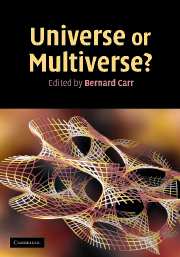
Universe or multiverse?


Universe or multiverse?

Recently there has been some peak of comments on the blogosphere about the multiverse, partially because of a new article by Linde and Vanchury titled How many universe are in the multiverse?.

But the battle against the multiverse, and it's buddy's, the anthropic principle and the string landscape are not new at all. Peter Woit is a championship of that cause. I have always considered P.W. as innocuous, and a source of information about string theory, even if he doesn't like it. Being he a mathematician, or at most a mathematical physicist it is not a lack of respect to his position in an university to not take seriously their objections to a branch of physics that he mostly doesn't understand.

But recently I am beginning to think that in fact he can be causing some damage. The problem I see is that he is so intended to criticise string theory that he only search the part that is good for his purposes without worrying of understanding the whole picture. Worse still, he can make believe that his biased view is the whole view. And that's very bad because it gives a very wrong perspective of what is being done in string theory, and in cosmology and high energy physics in general.

In particular what he says about multiverse, string landscape and similar topics is totally misleading. I am not saying that these are not conflictive areas. Only that what Woit says about them is not representative. To begin with one may realize that the existence of multiverses is, in some cases, inflation, mostly a consequence of already proved physicist with the only assumption of some special issues on he potential of the inflaton. Also, if one trust string theory, the multiverses would rise as a consequence of a saltatory cosmological constant. In fact that two scenarios are similar in spirit, although very different in the details.

If a reader of this blog would want to get a much better idea I would recommend him the reading of the book presented at the beginning of this entry. IT is edited by Bernard Card, who also makes a presentation chapter and thematic one, "the anthropic principle revisited". The firs chapter gives an overview of the rest of the book and explains the many meanings of the term "multiverse" that are treated.

The book itself is bases in a series of conferences partially supported by the templeton foundation. The list of participants includes a list of very prominent physicist such as S. Weinberg, S. Hawkings, L. Susskind,A. Linde, P. Davies, R. Kallosh and a long etc. The list of topics is also very broad, covering many of the variants of the multiverse idea and why it raises in nowadays physics research.

I only have read a few (six) part of the articles and I am alternating them with other articles about inflation in string theory, supersymmetry breaking and general literature about the cosmological constant. My idea is that probably there are better alternatives for the apparent existence of an accelerated universe (and in general, possibly, for some fine tunning problems) but that it would be stupid not to read (at least a part of) what appears in that book if ones is concerned about it.

Monday, September 28, 2009

Collisions of universes

The arxiv blog took notice of an article about the possible existence ofo experimental evidence of the collision of universes. You can read it here.

For those people who has read the conventional cosmological sceneries, that is, a FRW type cosmology, slightly corrected by a very tiny cosmological constant and an early period of inflation the idea of many universes could sound to them very speculative. and probably the could immediately think that it is based on that "evil string theorists" inventions.

In these last dates my readings in theoretical physics have been mainly related to cosmology. I have learned that the most extended idea of the multiple universes is rooted in the "eternal inflation" and also by the alternative idea of "chaotic inflation". Those are inventions of cosmologists and not of string theorists, although the last ones have got the idea, merged it with ideas of Weinberg and the Bethe-Theitleboin mechanism and implemented it in stirng theory leading to the bousso-Polchinsky proposal, the KKLT realization of it and in last instance the whole odea of the landscape.

But, basically the idea of eternal inflation is independent of string theory. If one takes seriously the problem of the vacuum energy in QFT one is faced with the problem that this is of the order of the supersymmetry breaking (if one doesn't belive in supersymmetry one would have the planck energy). That energy would led to a very fast expansion of the universe when part of it is released by transition to a level with less energy. The whole thing is that that transition would not be simultaneous on all points. Then one would have an expanding universes coexisting with an stationary one. The expanding universes could, agian, suffer another phase transition to a less energetic vacuum, resulting in new expanding universe. and so on, in a nested proccess. This is, roughly speaking, the idea of "bubble nucleation" that I have mentioned sometimes in this blog without too many explanations.

Ideally that universes would be disconnected and couldn't collide. That paper on arxiv investigate the opposite possibility.

One consequence of eternal inflation is the possibility that there would be an infinite number of universes. Taking account of the fact that here are a limited number of configurations that results in the need that every event , and it's variants would happen an infinite of times. It is a variant, for practical purposes, of the Everet's "many worlds" interpretation of quantum mechanics.

Well, if in some way one could us that infinite worlds variants amazing things could happen. In fact some people propose seriously that quantum computers make basically that. They would be many copies of the same computer, but in different universes, every one doing an independent calculation. Some people even try to relate the quantum and the eternal inflation into a single mechanism.

All this is very CF like. I remember the film "the unique" by the martial arts star Jet Li. There the protagonist kills his copies in the other universes and recipes it's strength and knowledges.

If insome wya I could use that many worlds doubles I could read in detaillthis paper about a new proposal of unified theories, somewhat in the line of the everybody favourite surfer physicist. A superficial reading seems to suggest that the proposal is most satisfactory but I am skeptic about it.

Also I could read some other interesting papers in arxiv today, and advance with my own ideas faster. And I could write the article, in Spanish, about F-theory. In fact I am reading some further papers about F-theory and I'll wait a little bit before writing that entry.

Besides reading physics/maths I could dedicate more time to touch piano, to make some amateur composition of electronic music, to practice more hours in the week martial arts, and make also other sport activities. And I still would have time to read more CF books, go cinema, and etc, etc. But lacking that technology a most likely possibility would be to win some random game (euromillion or similar) and in that way I wouldn't have to waste time in "economic activities" (althought fortunately sometimes this overlap with my research/academic activities).

But even in the worst of cases I guess that I am going to have more time to dedicate to the blogs and think that there are a good bunch of interesting themes to write about.

Thursday, August 13, 2009

Recently on arxiv

Summertime, holidays, nothing important going on, isn't it?

Maybe, but in my opinion some recent papers on arxiv are interesting.

I am going to begin by CYBERsusy. The name can suggest some SF novel cyberpunk heroine. But not. It is an acronym for 'CohomologicallY Broken Effective Retro SUperSYmmetry'. The article is titled A new mechanism for supersymmetry breaking
in the Supersymmetric Standard Model
.

To break supersymmetry is a good thing and a new mechanism to do so sounds important. If, moreover, the abstract ends with "The theory also leads to a zero cosmological
constant after SUSY breaking." one could begin to feel seriously interested. Being so it was a bit amazing to see how it passed unnoticed in the "big guys" blogs (you know who they are ;-) ). So I investigated a bit and I found this old entry by Lubos: Dixon law firm: CyberSUSY.

I also found that there is a blog mantained by Jon Dixon in the theme, John Dixon: Cohomology, supersymmetry and cybersusy

Well, the Lubos article refers to an older version of the theory, maybe the new one has corrected the fails, but I guess that not too much.

Another paper that I have found intriguing is related to the cosmological constant and the expanding universe. It is this, Does Unruh radiation accelerate the universe? A novel approach to the cosmic acceleration" and it's arxiv. This is the abstract:


We present a novel mechanism for the present acceleration of the universe. We find that the temperature of the Unruh radiation perceived by the brane is not equal to the inherent temperature (Hawking temperature at the apparent horizon) of the brane universe in the frame of Dvali-Gabadadze-Porrati (DGP) braneworld model. The Unruh radiation perceived by a dust dominated brane is always warmer than the brane measured by the geometric temperature, which naturally induces an energy flow between bulk and brane based on the most sound thermodynamics principles. Through a thorough investigation to the microscopic mechanism of interaction between bulk Unruh radiation and brane matter, we put forward that an energy influx from bulk Unruh radiation to the dust matter on the brane accelerates the universe

Well, the two last papers were authored by a Lubos discredited physicist in one case and by a not well known Chinese team in the other so One can find reasonable to see no resemblance of them.

More surprising are the two next papers.

The first one is by mr. Brian "elegant universe" Green and coauthores by Daniel Kabat1;2y and Stefanos Marnerides. The title sound interesting, "Dynamical decompacti cation and Three Large Dimensions". The actual paper is this and this is the abstract:

We study string gas dynamics in the early universe and seek to realize the Brandenberger-
Vafa mechanism{a goal that has eluded earlier works{that singles out three or fewer
spatial dimensions as the number which grow large cosmologically. To this end, we
consider a dilute gas of strings on a large torus, so that strings typically interact at signifi cant impact parameters. A strong exponential suppression in the interaction rates for d > 3 spatial dimensions rejects the classical argument that string worldsheets generically only intersect in four or fewer spacetime dimensions. As a consequence of this suppression, a scan over initial conditions establishes that in the dilute regime
decompacti cation of d = 3 spatial dimensions is favored over d > 3.


Nowadays the trend seems to be bottom-up approaches where one consider the standard model as an input and looks for stringy constructions to implement it in a coherent way (this goes for intersecting brane worlds and for F-theory GUT's). But I think that still is very interesting to see how "natural" is to have a world with three macroscopic dimensions and this papers seems a good approach to answer that question.

There is another paper authored by two very well known string theorists, Joseph Polchinski and Eva Silverstein. It is this: Dual Purpose Landscaping Tools: Small Extra Dimensions in AdS/CFT.

Because my knowledge of the AdS/CFT is still limited to it's basics, the chapters in the Becker-Becker-Schwartz and Clifford Johnson books plus a not too successful reading of a few reviews I can't say too much about the relevance of the paper. But still it sounds important and I am surprised not to have read about it in the you know who blogs. Maybe it is just a question of time, who knows.

The last paper I'll link is this: The Search for a Realistic String Model at LHC The title is self-explanatory. The authors are well known people, James A. Maxin, Van E. Mayes, D.V. Nanopoulos (well, actually the last one is well known for sure).

It is about the construction of a realistic intersecting D-brane model. At first sight one could think that with the rise of the F-theory GUT models the interest on this kind of phenomenological approaches would have become somewhat outdated, but seemingly it is not the case. Possibly one of the reason is that there is a lot of literature on the subject of seeking signatures of this kind of models in the LHC. You can find many of the articles doing a search for "string hunters" on arxiv hep-th. As you can see recently there was a paper on that subject, "The LHC string hunters companion II". I am actually reading the paper that correspond to the first part. It is very illustrative on how the Randall-Sundrum sceneries are actually achieved in fully string compactifications through branes wrapped in "Swiss chase" Calabi-Yau manifolds. And it contain a lot of formulae for cross sections. I think that It can be useful to me if at last my idea about a tired light mechanism to explain the observations interpreted as accelerated universe expansion make any sense after all. Independently of that they are possibly the "state of the art" in string phenomenology out of the F-Theory GUT's and (M-)heterotic models. Possibly I'll make a dedicated post to this intersecting brane models some day. But for now I think that the reader already has a lot of papers to search for.

Tuesday, August 04, 2009

TGD in vixra

At last the pdf articles of Matti pitkanen about topological geometrodynamics have been uploaded to vixra.

If someone wants to beguin he would read Topological Geometrodynamics: Overview. Advise, despite the "overview" word in the title that pdf has 1000+ pages.

There are many other papers that the reader can find by himself in vixra.

I am aware that TGD is considered crackpot. For example Lubos said in a recent post (not specifically about TGD) that TGD only existed in Matti Pitkanen's imagination. Maybe, but I think that Matti is a nice smart guy, with a correct behaviour, and he deserves the right that someone with an accredited academic position claiming that TGD is crackpot would do a proper debunking of TGD (a reasonable part of it, it is not necessary to debug the whole 1000+ paper).

But surely I am not the right person to do such a debunking. Instead I'll debug in a separate post another paper in vixra, The Graviton Background Vs. Dark Energy. The abstract says:

In the model of low-energy quantum gravity by the author, cosmological redshifts are caused by interactions of photons with gravitons. Non-forehead collisions with gravitons will lead to an additional relaxation of any photonic flux. It gives a possibility of another interpretation of supernovae 1a data. Every massive body would be decelerated due to collisions with gravitons that may be connected with the Pioneer 10 anomaly. This mechanism needs graviton pairing and "an atomic structure" of matter for working it. Also an existence of black holes contradicts to the equivalence principle: any black hole should have a gravitational mass to be much bigger - about three orders - than an inertial one.

As the readers of this blog can deduce the author of this paper is presenting a TLT (tired light theory) as a replacement of the big bang. And the will remember that I had being considering the possibility that a TLT mechanism could be used to give and explanation of the supernovae data that is being interpreted as evidence of an accelerated expansion of the universe. I have developed a little bit more my ideas and I am not sure if they work, but as far as I see what that article says makes not special sense. I'll try to explain why in the next post.

Tuesday, July 28, 2009

Easy latex on blogpsot

I had said that I wanted an easy way to use latex on blogspot. Untill now I was using an external mimetex server and using the html img tag with the url of the mimetex cg and latex code in it. The idea was to create some kind of customized tag that would write the html code. That has too good points. On one hand it makes the edition of the post easier. On the other if the mimetex cg is changed you only need the link of the cgi in the script code that is asociated to the tag.


In order to do so I have tried to study the blogspot templates structure, but I have not found too usefull information. Most that I hve found is concerning the look of the blog and I am not too interested in that kind of things. I have tried to see if I could create tags, but I have not found too much info. I have made an easy javascript function, but it was not of too much help.

Fortunately I have found someone who made the work for me. You can read how to here. As you can read there once you add a personalized javascript gadget to your blog you can insert your latex code inside two dollar symbols and it its replaced by the right latex image when you publish the entry.

The code behind the scenes is this. I have not had time to study it. If you follow the stepts indicated in the webpage I linked before that javascript is called from a remote .js file and you can't customize it. Obvioulsly one could write the whole javascript code in the customized gadget or create your own copy of the js file whereever you want and customize it.

One bad aspect of the latex, as I use it in this blog, is that the images have some annoying borders, as you can see:

$$E=mc^2$$

I think that this problem can be advoided doing some CSS to create some tag for latex images but that is something that I'll do sometime later. Also I would like to study that javascript to use the wordpress tag for wrting latex, $latex the code goes here $ instead of the tow dolar symbols, in order to improve the crosscompatibility betwen blogspot and wordpress. But, anyway, that are minor questions, the hard problem is solved. Now it only remains that I would post about physics and write the equations, of course ;-).

Monday, July 13, 2009

Strings 2009: the slides

This year the annual conference in string theory, celebrated at Roma, has not had an internet live TV broadcast as it happened the last year.

Because of that reason I didn't do a post about the topic. I have waited until the slides where out and I could have read some of them. The slides of conferences, if they are detailed enough, are a good thing because they are addressed to non specialists in that particular field, so they can be easily read, and they condense a great amount of information from various papers.

You can get access to the lists of talks, wth the corresponding slides, here.

I have read a few ones already. The first was the one given by Howava. I was greatly interested in reading how he defended his theory against the recent papers with showed the problems of renormalizability it seems to actually has, despite of being power counting renormalizable. Well, I didn't see any mention of it. The slide talks about the "foundational" papers on the subject and explains it's relation to the M2 brane of M-theory, to the CDT (causal dynamics triangulations) result that in the short length the effective dimension of space time is near 2, and that his theory resembles that, and a few other topics. I find specially curious that one of the motivations for his theory is that string theory violates Lorentz symmetry. Well, I am not sure why he says that, but certainly said without further explanation looks weird. It is a pity that there was not live streaming, nor non-live videos, of the talks so one can't see what questions people made him.

About the F-theory GUT's there were three talks. One from Vafa. It's ppt (than not pdf) is very schematic and without some previous knowledge on the subject I am not sure how much information one can get from it. Anyway, if one reads the papers I cited in my post about F-theory for non experts maybe he could get a much better understanding. Vafa makes a decent work explaining the two foundational papers, the paper in cosmology, and the paper in LHC footprints, that I have read. It also talks about some papers I haven't read, as for example the ones in gauge mediation (although I had read some resumes of the results). The conclusions seem to be that there are two clear predictions from their models. One, in cosmology, is that the dark matter candidate is the gravitino. that rules out models on WIMPS and implies that ATIC, PAMELA and similar results that seems to indicate an anomalous ratio of positrons over electrons over certain ranks of energies would have astrophysical origins. Or not exit at all. Recent results from FERMI/GLAST seem to contradcit ATIC and PAMELA (see, for example this post by Jester, in resonances blog) would agree with this prediction.

The other prediction mentioned on the slide is that there will be some charged track on the LHC leaving the detector. It would be due to the NLSP whose lifetime, 10^1-4 secs, is long enough to allow it scape from the detector.

There are two more talks about F-theory. One by Sakura Schafer-Namek. I have read it but from all the part related to spectral covers I coudn't get any useful informrmation. I simply don't know enough form that mathemathical topic. The other paper in F-theory is the one by Jonathan Heckman. It is centred in flavor hierarchies for quarks and leptons. Well, an interesting topic for sure, but not my favourite one. Anyway the slide is good enough to get some general idea of the topic from it.

Another paper I read is the one of Strominger about the KERR/CFT correspondence. About that topic I only had read a paper dated from the last summer. Well, I am not sure if too much progress has been achieved so far neither I have clear whether the whole field is terribly significant, but possibly that is my fault.

Possibly the most awaited paper was the one from Nima-Arkani-Hamed about twistors and the S-Matrix. There are rumorology out there saying that it's not a paper in string theory but an attempt to create some kind of supersymmetric GUT diferent from string theory. I haven't still read the slide and I can't say anything about. But for sure it is a theory that many people will discuses sooner or later, possibly when the actual paper on the subject would be out.

I'll possibly read more slides later, but I am not sure if I will post about them. But everybody can try to rad the linked slides by themselves. There are good choices that anyone with a decent basic on high energy physics could get some amount of info from them.

UPDATE: In a thread in physicis forums someone, seemengly well informed, said that actually Horava recognized the problems recently found in his theory in his talk as strings 2009. Also the same physic forums poster explained that the actual problems where that one couldn't decouplee the gosths from the theory. Curiosulsly that has lead to a posible reinterpretation of that gosths as dark matter. I have not read the relevant papers but at first sight that looks very bizaree. Gosths are negative norm states tht usually appear in the quantizationo of gauge theories as intermediate states that can be shown not to appear in external legs, i.e., are no observabbles. Toclaims thatusually unwanted negative normed states can go in external lines and actually represent viable particles (in the form of dark matter) seems like one could try to do the same thing for any theory and one wouldn't need gauge theories. I suppose that there will be something special in that gosths that make them diferent from the usual ones and permits people doing such conjectures, but, as I said, looks an a priory contravied claim.

P.S. I am looking for an easier way to use LaTeX in this blog that the one I am using (writing the latex code in the url of an image generated by an external LaTeX server). If I don't find a good solution I would seriously consider the option to migrate this blog to wordpress where writing LaTeX is "natively" supported (that's the reason I make an extensive use of it in my other blog).